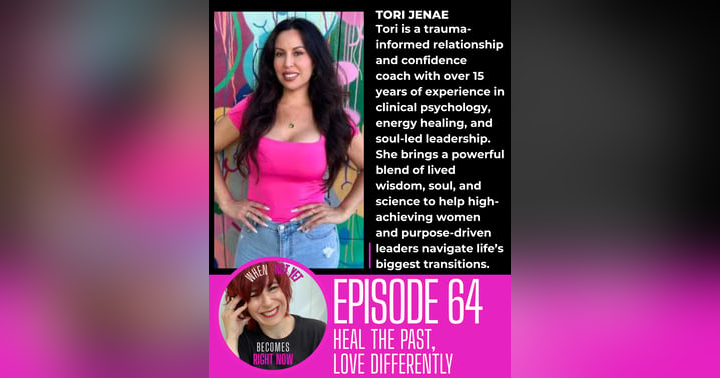
Heal the Past, Love Differently with Tori Jenae

Send us a text In this episode, Tori Jenae, a trauma-informed relationship and confidence coach, shares her powerful journey from a traumatic childhood to becoming a successful coach. She discusses the impact of generational trauma, the importance of understanding love maps in relationships, and how her experiences have shaped her approach to healing. Tori emphasizes the need for self-care, vulnerability and the transformative power of turning pain into purpose. She also explores the integrat...


In this episode, Tori Jenae, a trauma-informed relationship and confidence coach, shares her powerful journey from a traumatic childhood to becoming a successful coach. She discusses the impact of generational trauma, the importance of understanding love maps in relationships, and how her experiences have shaped her approach to healing. Tori emphasizes the need for self-care, vulnerability and the transformative power of turning pain into purpose. She also explores the integration of energy healing into her practice and the significance of empowering clients to reclaim their lives.
Key Takeaways:
- Tori Jenae's journey is rooted in overcoming trauma and adversity.
- Understanding love maps helps to recognize relationship patterns.
- Generational trauma can affect multiple generations and needs to be addressed.
- Healing requires self-awareness and the ability to receive care.
- The importance of vulnerability and self-care in personal growth.
- Energy healing complements traditional psychological practices.
- Empowerment comes from recognizing one's own strength and resilience.
Episode Highlights:
[02:07] Tori's Origin Story and Early Life
[03:30] Transforming Pain into Purpose
[06:34] Understanding Love Maps and Relationships
[09:57] Generational Trauma Explained
[18:59] Healing and Self-Care in Relationships
[31:38] Tori's Signature Method and Client Work
Resources Mentioned:
Tori’s Website https://www.torijenae.com/
Connect with:
https://www.facebook.com/manifestsoulsuccess
Go to http://www.mymoodymonster.com to learn more about Moody today!
My Moody Monster® - a Buddy for Feelings
Moody is more than just a plush doll, they are a safe way for kids to express frustrations.
Disclaimer: This post contains affiliate links. If you make a purchase, I may receive a commission at no extra cost to you.
Subscribe and Review Us on Your Favorite Podcast Platform:
Apple Podcasts: https://podcasts.apple.com/us/podcast/when-not-yet-becomes-right-now/id1767481477
Spotify: https://open.spotify.com/show/25eQxhfgLvdt3G9rY68AEQ?si=dc60122b6bc34484
Amazon Music: https://music.amazon.com/podcasts/2f6dece0-0148-4937-b33d-168b5aedf52a/when-not-yet-becomes-right-now
iHeart Radio: https://iheart.com/podcast/214320962/
Follow us on Social Media:
The When “Not Yet” Becomes “Right Now” Podcast: http://www.whennotyetbecomesrightnow.com
Instagram: http://www.instagram.com/notyettorightnow
TikTok: http://www.tiktok.com/@notyettorightnow
Facebook: http://www.facebook.com/notyettorightnow
Threads: ...

When Not Yet Becomes Right Now (00:00)
Welcome to When Not Yet Becomes Right Now, the podcast where we dive deep into the moments of transformation, the times when not yet shifts into right now and everything changes. I'm your host, Jen Ginty and this podcast is all about those pivotal moments in our life journeys. You know the ones, when the hesitation fades, when we take that first step, even if it feels like a leap. It's in these moments that growth and healing begins. Each episode will explore stories of resilience,
moments of clarity, and the sparks that ignite real change. From personal experiences to expert insights, we'll uncover how people navigate the complex journey we call life and come out stronger on the other side. Whether you're searching for that spark in your own life or just curious about how change unfolds for others, you're in the right place. We'll discuss the ups and downs, the breakthroughs and setbacks, and how to embrace the right now, even when it feels out of reach. Because sometimes,
The hardest part of the journey is realizing that the moment you've been waiting for has already arrived. So take a deep breath, settle in, and let's get started.
Jen (01:09)
Hello and welcome to When Not Yet Becomes Right Now. Today we're joined by Tori Janae, a trauma-informed relationship and confidence coach with over 15 years of experience in clinical psychology, energy healing, and soul-led leadership. She brings a powerful blend of lived wisdom, soul, and science to help high-achieving women and purpose-driven leaders navigate life's biggest transitions, whether that's divorce, burnout, or grief.
On a mission to help 1 million people heal through her signature method, courses and upcoming book, Tori is here to share how we can rise, reclaim our voice and step fully into who we're becoming. Welcome Tori.
Tori Jenae (01:51)
Thank you so much, what a beautiful introduction. ⁓ I am too. We've been planning this one for a little while, so it's been been on my mind.
Jen (01:54)
I'm so happy you're here!
Yes!
Okay, well let's get into it. What is your origin story?
Tori Jenae (02:07)
Yeah, I like to start where I am today and then paint backwards because it's kind of an interesting thing. today I do have, you know, three degrees in psychology. I live in Beverly Hills, California. I have a successful practice. But none of that was supposed to be possible for me. I was actually conceived in a heroin rehab facility to a mother who was luckily, like, you know, by the grace of God, getting clean from heroin.
My father was already married, so I was the result of an affair. already had, and my mom didn't find out that I was, until I was in existence in the pregnancy, that's when he divulged that, actually I'm already married with two kids, so I don't really want anything to do with this. So I was born to a single mother who struggled with addiction. She did kick heroin, but unfortunately drugs and alcoholic pills, cocaine, drinking.
a lot of things and at one point meth were still part of her journey and she didn't get sober till about a year and a half before she passed because she actually ⁓ OD'd but she survived that OD and there was just a lot of trauma, a lot of difficulty, you know, kindergarten through sixth grade, I think I went to seven different schools. So there was many boyfriends and husbands and they were all addicts too. So I was really surrounded by nothing but chaos and trauma and addiction.
everything from neglect to abuse I've experienced. And that was just my childhood. So I left at 17 years old, I took care of myself, I helped raise my little brother, put myself at the university, never took out a single loan. I paid cash for everything because I had to. I made too much money to qualify for all the free grants already because I'd already been self-sufficient by the time I went to college at about 20, 21. And then, you know, in my adulthood, I had...
all of my family start passing away. So my oldest sister first, she died of a drug overdose. Then my mom passed. And my grandmother, was probably the only person, my brother's grandmother, who helped raise me in some normal capacity, my father passed. So in a 10-year span in my adulthood, I lost everything. My health, my money, my marriage. And that was a long-term marriage to a good man. Again, gratefully, we're still good friends, and we split amicably.
but it was the longest relationship I'd ever had. We were together for 18 years. So that was a big loss. It was just no longer aligned, but it was kind of like everything I worked so hard to build was gone. And so what I teach comes from a place of experiencing, transforming, and surviving profound trauma, the kind of grief that will crack your soul open, the kind of loss that there isn't anything I haven't lost yet. I've been cheated on, I've been betrayed, I've been...
abused in every single way. So I just love to share that because A, I don't think we talk about that stuff enough and B, I want people to know that yes, I've got the fancy degrees. Yes, I've done multiple trainings, but the biggest experience I bring is that I've walked through the fire. I've lived this stuff. I've had to heal it. I've had to feel it. I've had to live it. And so that's where I really love to share how to do those things because I've had to do the hard things myself. And I've also just to
because I come from a very long line of drug addiction, I decided before I ever started to become sober completely at 21. I just thought that for me, drinking drugs, all that stuff was Russian roulette. So I've also walked through all of these things without a single drink or Xanax or anything. I've done this stone cold sober from day one. So I love to teach people how do we get through anything, how do we heal, and how do we really become powerful creators of our life.
Jen (05:57)
Well, you are definitely a strong and powerful woman. There's no doubt about that. I can tell you. And it's so interesting the way that we ⁓ align ourselves when we have walked the walk, that we, a lot of us make the decision to do something to help others who may be in that similar situation, right? ⁓
Tori Jenae (06:00)
You
Absolutely. And that's the greatest
gift is like turning my pain into my purpose and making my story of survival someone else's guide.
Jen (06:34)
Absolutely. you talked about how your mother was an addict throughout her life and that you also ended up in relationships with addicts. Is that something that is typical? Okay.
Tori Jenae (06:52)
Absolutely. And
luckily it was my early relationships, like in my teens and early 20s. The man that I ultimately married, he didn't have a major addiction, thank God. But absolutely, my first boyfriend was a drummer who did a lot of drugs. ⁓ And we lived together and it was chaotic and was messy and was yelling. It was everything I grew up with. And what I love to explain to people is that the way our love maps formed is the first loves that we had. That feels like love.
So even if it's chaos, even if it's negativity, even if it's yelling, it's all the things you said you'd never do, that is imprinted in your nervous system, in your psychology, as this is what love looks like. And so it's not our fault, but it's our responsibility to heal within ourselves. You I always joke that like for me, particularly when I was younger, mean, tall, dark, and emotionally unavailable with a drug addiction was the sexiest guy in the place.
or if he had some mental emotional problems, I will heal him, right?
Jen (07:50)
Yep.
Yep, yep, same, I've been there, absolutely.
Tori Jenae (08:00)
So I love to share that so that we know that we're not broken, there's nothing wrong with us. That is just what was imprinted in us as love. And there's so much we can do. And the first step is recognizing that that's what it is. Even if it's just having a critical partner and you're like, my gosh, my mom was so critical of me. And I recognize now I've got this critical partner. Or my dad worked all the time and he was absent. And so now I've got this partner who works all the time and is absent and isn't showing up for me. There's so many parallels we can draw.
And really the purpose of romantic love is to heal our primary connections with our parents. So all of that stuff will show up in our love relationships and it's designed to.
Jen (08:43)
Wow, that makes a lot of sense. And you said love map. Could you explain what that is?
Tori Jenae (08:47)
Mm-hmm.
Yeah, so love maps are different depending on who you speak to. My version of love map is how was love in my psychology, in my wiring, how was it mapped? So for me, love was mapped as I need to take care of you because my parents both struggled with addiction. You know, my stepdad and my mom struggled with addiction. So it's kind of like my map was, okay, it's all right if you have problems. I don't need to have boundaries. I will take care of you no matter what you do to me.
I will still love you. I'll keep showing up. I will sacrifice myself if that's what I need to do. And no matter how chaotic you are, I'll stay calm. And that became my love map. And so that was how I thought love looked like. It looked like codependency. It looked like sacrificing myself. It looked like doing whatever it is I needed to do, never telling anyone that they hurt my feelings because my parents couldn't handle that.
Jen (09:45)
Yeah, and it sounds like, you know, you think your childhood is fairly normal because that's all you know, right? That's how I lived my life.
Tori Jenae (09:51)
Totally, yes.
Yes, and we all think our childhoods are normal and we typically don't even start recognizing it until we get out of like, you if you go to college or university, like that's when you start getting around other people. You start to notice like there's different ways in the world. Like I even kind of thought my childhood was somewhat normal, right? It's all I knew. And then I remember being a young psychology student at about like 1920 being like listening to like what trauma was and
all these issues and it's like I knew that there was something wrong with my household because I hid it. I didn't really tell people about it. So instinctively I knew that this isn't quite right and I knew I should hide it. But it wasn't until I started learning and hanging out with other people's families and saying like, wow, like my family has really got some issues. And again, it's never about, so many of my clients have such a hard time because they feel like, I don't want to blame my parents. That's such a cop out. It can't really be all about my childhood.
It is. And it's not bad. Your parents did the best they could with what the tools that they had. Even my mom. She had a ton of trauma. Everything she did was a direct result of what happened to her. And at this point in my life, I have such profound compassion. I've forgiven her. I know that, God, she made me strong. Like she was tough. Like the things that she, you know, she was orphaned by the time she was 17. She'd had my sister. She was forced to marry the dad who she didn't love just because at that time they made her drop out of school and get married. It was just like,
all these horrible things that happened to her and she was doing the best that she could. And so it's never making our parents bad or wrong. It's saying what happened to me and what I learned about love and relationship does not serve me anymore. And so I want to heal that and stop that for my family. And that might just be codependency. That might be over-giving. That might be people-pleasing. For me, was a lot of things. It was codependency. was addiction. was...
toxicity, but we all have something in our family that we need to break that generational trauma.
Jen (11:58)
Yes, yes. I was thinking as you were talking, was like, generational trauma, generational trauma, right ahead, right ahead, square ahead of us. And I'm not sure that people truly understand what the term generational trauma means. Could you maybe give a little bit of a description?
Tori Jenae (12:00)
Absolutely.
Yeah, it's such a new study, honestly, and this is something that we're learning with neuroscience, and I love to give this idea to you. You, as ⁓ a being, your mother, women are born with all their eggs, so your mother was inside her mother, so you were technically inside of your grandmother. That means your genetic material experienced all the stress that your grandmother did. Then your mother experienced it, and it just keeps getting transferred down. So let's say,
We saw this, where they first learned this was with actually with Holocaust survivors. So they found that two to three generations removed from the person who was actually in the Holocaust, they had the same exact genetic markers of stress in their bodies, even though was like their grandmother who had actually survived the Holocaust. So they started to learn that that stress transfers down through the genetic material. So that's one form of genetic trauma is it literally can like imagine you had
three generations of people, you know, I work with a of people in the UK, maybe there was massive famine. And so now you've never experienced food insecurity in your life, but that's a constant fear for you. It's because it was actually passed down through your genetics. And if we even look at it from an evolutionary perspective, all of us are born with certain fears. We are born afraid of heights, spiders, snakes, certain things that...
our ancestors passed down to keep us safe. It was like, you know, this killed us a lot before. So we're going to kind of encode it into our genetics to be scared. And so we have very ancient nervous systems. So our old nervous system in our brain does not know the difference between the stress of a big tax bill and a bear coming out of the woods.
And so that's why we just go into fight or flight. But when we particularly through our genetics, like it can be through the genetic material, something like they saw in Holocaust survivors. They also saw this in animal studies where they had one generation of bunnies because they reproduce fast. So you can use them that way. And what would happen is every time they smelled peppermint oil, they would lightly shock their feet. So not like so much, but enough to make them scared. And then what they did is they had like seven generations.
Only the first generation was exposed to that stimulus, but every subsequent generation was still afraid of peppermint oil. So we're so much more wired to survive than I think we know. And so I love to look at this in your origin stories. Like I have two good friends who are Russian and we've looked at this a lot with like, what was it like for their mothers were in communism? And how has that showed up in their story with like...
money and independence and even though they came to school, they came to the US and they've gone to university here and they've essentially become American, that is still encoded in them. So it's like, what are the things that I love to have my clients like do kind of a brain dump of like, what were the stories I was told? What were the things I was told? I was told like money doesn't grow on trees. You can't trust men. You know, these are things that if we look at they were passed down in our mother.
or whoever raised us, their person who raised them, you know, like these have been passed down to us. So it's, I think it's mental, emotional, and then I even kind of look at the spiritual of how we gain this form of trauma that isn't, it's designed to keep us safe, but without that awareness, it really keeps us stuck.
Jen (15:56)
That's powerful. And I used to call my sons little cavemen because they were born with all of these emotions. They were born with all these ideas in their head that they didn't know what to do. And I think after you explaining generational trauma, even more so they were cavemen because they were imprinted on for so long. It makes sense.
Tori Jenae (16:20)
Absolutely. And we have to have that awareness.
Jen (16:25)
Yeah, and think another theme that seems to pop up, especially with people who go through childhood trauma, is growing up too soon.
Tori Jenae (16:34)
Absolutely. Yeah, we call it parentified adults or parentified children because sometimes we become the parents. But yeah, we don't get to have like innocence or childhood. And that was definitely me. I mean, from the time I was seven years old, I was helping to take care of my brother. It's like I had a baby when I was that young and I would have to grocery shop. There was a lot of things I had to do to like survive. And so there's gifts in that. But it really does take away our ability to be cared for, to trust people, to not
responsibility for everything and everyone and I think these are some of the core patterns too of perfectionism and people-pleasing that I've seen.
Jen (17:12)
Yes, absolutely. Especially if you're that child who had had to do it. Like you said, you had a brother that you had to raise. I had two older brothers that I basically was that kind of protector against our abuser. I would throw myself on top of them, that kind of thing. So it was always this idea that I was in charge of people's emotional capacities.
Tori Jenae (17:27)
Yeah.
Yes,
yes, and that's such a powerful realization and it is so limiting when we're in relationship because we feel responsible for them and that's how we show them our love and it's so big-hearted and to think that you did that for your brothers and what you probably saved them from because you were actually strong enough to hold it.
Because I think about that with my little brother too. He's just tender. He's loving. He's got a soft soul. And I'm so glad that I was able to prevent him from breaking that. For me, it was different. I was strong. was, or you know, not to say, I say that you can be a happy woman or a strong woman. I want to be a happy woman at this point. I'm tired of being strong.
Jen (18:19)
I agree.
Yes.
Tori Jenae (18:22)
So
I don't want to promote strong. used to be something about myself that I loved. like now I'm like, I don't want to be strong anymore. I want to be vulnerable. I want to be soft. I want to be easygoing. I know, all these things. So I just like to like, I want to lay that foundation. Strength and courage is being vulnerable is being held is, you know, all these things too. So, but yeah, it's like you were able to do that. And so many of us did, you know, so many of us who survived childhood trauma.
did things that we had to do to survive, but they are things that will not let us thrive.
And that's the hard part.
Jen (18:57)
Another powerful moment.
No, because I think back to the relationships that I've had with husband, ⁓ boyfriends, even friends where they don't mean to rely on me. They don't mean to put that on me, but it feels like they feel it from me. So they just accept it.
Tori Jenae (19:21)
Yeah, because we show up and give that and it's such a gift, right? It's like, wow, this woman is going to take care of me. She's going to handle things, you know, and they get to relax. And exactly, that's the thing is like that reciprocity is so important and it's hard because when you grow up with difficulty and I even like to remind people like this, you know, my parent was an addict, but your parent may have just been chronically stressed or sick or
Jen (19:34)
Do we?
Tori Jenae (19:51)
emotionally checked out. are, those all still kind of put it emotionally back on us, even if it wasn't traumatic per se. There was still an energy of I've got to take care of this. I've got to take care of myself. I've got to take care of my siblings. And so it shows up the same way. And then we don't know how to receive care because we didn't ever get it when we were forming what we call attachment. So it's like,
I didn't know how to ask for help. I didn't know how to let somebody take care of me. My ex-husband was the first person I'd ever trusted enough to actually do stuff for me. Like there was a funny story when we first got married and we'd bought like a little condo and I had the flu really badly. And I came like crawling on my elbows, like army crawling out of the bedroom to the kitchen. And I'm like crawling across the floor and he's looking at me like, what are you doing?
And I was like, I'm thirsty, I really need water. And he's like, why didn't you just call for me? And it was like, I had never been able to call to somebody to get me water. So it didn't even occur to me that I could do that. And so those are the moments that we don't recognize, like, ⁓ I don't reach out or I don't even know how to do that. I don't know what my needs are. And that's a big one I work with on women. They don't know what their needs are.
Jen (21:14)
Yes, I still searching. Still searching to this day.
Tori Jenae (21:18)
And it's a lifetime. And as we grow, change,
evolve those needs, you know, they do change. But I think as often as women, we're so used to giving, and particularly if we had a challenging childhood, we are hard, we are wired to be the giving, doing, being one. And so it's like, gosh, like if I thought about it, like what is it that I actually need from this person in my life? And our romantic relationships, like I said, they are the most profound.
places in which we learn and they are designed to be that way, it brings up all of our stuff. Our kids, our partners and sometimes friends will do it too. But I've seen that you know we really bring our most wounded selves to our relationship and it's meant to be that way because that is the container in which you can heal it.
Jen (22:09)
makes sense. Now do you think that this ⁓ this taking care of others did that make you think I want to maybe go into psychology?
Tori Jenae (22:22)
So most of
us with traumatic childhoods end up being of service. It is just like, I think we're designed that way and it's not a bad thing, but we have to learn how to take care of ourselves and heal ourselves before we really start doing it with others. But my ex-husband was like head of the large fire department agency. And it was interesting because it was the same thing with firefighters, ⁓ doctors, like I've looked into this, doctors, nurses, firefighters, psychologists, therapists, all these people.
Jen (22:28)
Right.
Tori Jenae (22:53)
typically have difficult backgrounds and we are comfortable rescuing, saving, taking care of. And so it's a great gift, but the thing we have to really be mindful of is how am I avoiding taking care of myself? How am I taking care of others in a way that actually makes me not work on my own healing, on my own health, on my own wellness? Like they did a large study on nurses.
And there some of the most unhealthy people around. And it's so sad because they're so loving and so many are so giving and so loving. And that showed that, again, that over giving, that overdoing, that nurturing, can really, it's a double-edged sword and we have to be very mindful of it.
Jen (23:22)
No.
Yeah, that reminds me of the story of when I was in labor with my first son. The nurses were trying to take care of me, but I honestly didn't know how to let them. And one nurse looked at me and she says, you come from like a childhood abuse background, don't you? And I'm like, yeah, I do. And she's like, yeah, because you're not letting us take care of you. You're trying to do this all on your own.
And she saw that in me. And I don't know if that was a similar background for her. But when you say that that nurses go into that field for those kinds of reasons, it makes me now think, ⁓ she may have also been in that background to recognize it in me.
Tori Jenae (24:27)
Yeah, she probably was and she'd probably seen it and she was now able to recognize it in others. what I love to like, and I know you get this, but like for our listeners, like there's nothing wrong with us that we can't receive it. It's that it was not safe to receive care. It could have come with strings. It could have come with backlash. could have ⁓ like really blew up on you or that person who was caring for you just wasn't a safe person. So you couldn't receive it.
So again, it's like there's nothing wrong with us. That's how we kept ourselves safe is by pushing that away. It's by saying, I've got it. I can do it on my own. I don't owe you anything or you're not in my space to make me unsafe. So it's a very unconscious protection mechanism that takes a lot of awareness and work and self-trust to go into.
Jen (25:10)
Yeah.
Yeah. So you are pretty much on your own. Is your brother still with you while you're in college?
Tori Jenae (25:30)
Luckily his grandmother, he lived with her for a while. Unfortunately her son, who was his father, would still be in and out so he still was exposed to that trauma. But for the most part, you know, she did feed Shelter and love him and so that is good. And then he came to live with me again when I got married and had a house. So he ended up. But you know, luckily we're still very close. He only lives a few miles from me now. There isn't a day that goes by that I don't talk to that boy.
Well, he's a man now. But it's, and as you know, have sons, even though he's six foot three, like 190 pounds, he'll always be 10. Yeah. It's so crazy when they get that big. It's like, why are you so big?
Jen (26:01)
Aww.
Mm-hmm.
Yes, absolutely. My son just turned 19 and 6'2", 190, right? And just...
Right,
right, exactly. And so you went into college and you knew right away that you wanted to focus on psychology. Tell me a bit about the process for you.
Tori Jenae (26:32)
I did.
It was kind of funny. I went into college and initially I was like, well, maybe I'll be a doctor. And then I went into that and I took my first like psychology class and that was it. I was like, this is exactly what I'm here to do. And it was, pretty naturally to me. Cause I, you know, I've been reading people my whole life just to stay safe. was like, that's one thing too that childhood trauma gives us is that we can really read people's moods and energy to, and.
it makes us very intuitive in a very specific way. And so that's another gift. And sometimes we actually have to learn how to turn that off because we can over tune into people and really know too much about what's going on in their inner world and lose ourselves in that. So I always love to share that. But yeah, for me, I went into school. I was what they call a non-traditional student. So I always went to school close to me. I never really got to have like the college experience per se because I always needed to work.
pretty much like full time all the way. I did work full time all the way through. And so I was like that evening, morning, I would literally like go to class in the morning. Like I'd do the 7 a.m. classes, I'd go to work till five and then I'd do like the 6 p.m. classes. So it took me a little bit, it took me like seven, eight years to get six years of, you know, six plus years of college in. But I did it and I'm the first person to graduate.
think high school and college in my family. Yeah, so it's really like, what do we set our minds to and what do we want to achieve no matter what we've come from? it's, it's, I just, some part of me knew that if I was going to make a different life for myself and for my brother that I was going to have to get an education. And so I really put a lot of effort and energy into that. And I didn't even, you know, when I was younger I didn't even think about like having kids or anything. It was like, okay, I've got to.
got to get through school and I've got to get financially stable because that was something I'd never seen a woman do in my lifetime.
Jen (28:35)
Yeah, just breaking barriers. Yes.
Tori Jenae (28:37)
I was sure trying, nearly killed myself doing it,
burnt myself out, but I did it. My cat loves to make them. I was. I met my ex-husband when I was 23 and we were together until about 43. So I think I got married to him when I was about 25, but we, yeah, he was, he was definitely a positive import.
Jen (28:43)
No, were you married? mine will probably jump up.
Tori Jenae (29:03)
influence in my life and you know know that there's a lot of things that had we not had that partnership and shared bills and done all those things together that I would not I definitely wouldn't be where I am today if it weren't for him.
Jen (29:16)
I'm so
glad that you keep a nice relationship with each other.
Tori Jenae (29:20)
Yeah, was, you we didn't divorce because we hated each other. That was actually what it was was hard about it. And I, you know, I just always share the story because I think maybe other women can see themselves like he's a good guy and I'm a great woman. But it was like we had got together so young and I don't think I knew who I was and or what I truly wanted or needed in a partner and probably the same for him. And we just had because I came into that marriage before I had done my healing work and before he'd done any of his.
I think we just created so many bad habits in our communication. Like there was a lot of sweeping things out of the rug and not wanting to talk about it. And we're both highly avoidant. So we just avoided all the problems and then they just became mountains that we could no longer cross to reach each other. ⁓ But there was still always a level of love and respect there. so even though our divorce wasn't easy, because the divorce just isn't easy, having built a life for 20 years and then have it be all gone in three weeks after doing it.
Thankfully, I worked really hard to be loving, go high no matter what was said or done, call out behavior and then step away when it wasn't working and just be like, hey, come back when you're calm again. And then we got through that. so that things fell apart in 2021, filed for divorce in 2023. And now in 2025, I definitely feel like we're still incredibly supportive of one another. We still talk. We both have, he has a girlfriend, I have a boyfriend.
We both know about that. I've met his girlfriend. So we still have this amazing relationship. And he's someone I will always love and I'll always be there for. And I know it's the same for me.
Jen (31:03)
That's so wonderful to have that kind of energy together.
Tori Jenae (31:07)
Yeah, you can't spend 20 years of your life with, or at least for me, like now again, he didn't do anything horrible to me. So I know this is different, you know, but like getting to a place in my life where I can ⁓ love and forgive and still have boundaries has been a big life lesson for me.
Jen (31:13)
Right.
So when did you decide to get into the energy healing part of the, I'm assuming that you wanted to add this to what you did?
Tori Jenae (31:36)
For sure.
Yeah, so I started, so I've got a clinical psychology bachelor's and then a second, and then I've got a master's in psychology and then I've got a secondary master's specialization in transformational coaching. Cause I decided in school, like after learning to be like, you know, kind of doing the therapeutic role, role, was like, it's not completely aligned, but I came out of school and I had my coaching practice for like two years. And I really realized that like, okay, people,
can talk about things, but it's taking so long for them to actually ground that knowing in their body and not have the reaction. So I really saw that there was like this missing piece of like, if we're not healing the body, the nervous system, the visceral reactions that we have when we get triggered and we get upset, when something bad happens, we're not really able to mentally take over. And then,
And in about 2015, the book, The Body Keeps, the score came out. And that's a famous book on trauma. And it's really all about, it's a meaty book to read, but I think it's really designed for practitioners and people who do this work. But the basis of it is that all chronic stress and trauma is stored in the body and the nervous system and the way we react. So it's unconscious to us. And so that was something I already really guess I knew from my own experience, but I was like, how do I find something that I can do with clients?
Jen (32:41)
Yes.
Tori Jenae (33:04)
that can be body based, but I can do it from anywhere in the world and I can teach them how to do this. And that's where I found, through a good friend of mine, energy psychology. And she had described it as something too, like she had a very traumatic childhood and she said she'd found a therapist who did it with her and she's like, I know I wouldn't be where I am now if I hadn't done that work. And so the energy psychology has been around for like 50 to 70 years. It's well studied. It reduces cortisol. It does a lot of things, but it's basically like tapping points.
EFT is another form of it. Energy psychology is a little bit different because we have different algorithms. do blocks to healing. It's just a little bit... It's kind of like I jokingly say I love EFT. I'm trained in EFT too. So I always say energy psychology is just EFT on steroids.
Jen (33:48)
Okay. So is this.
Tori Jenae (33:49)
It just goes deeper.
It's a different level. It's a longer process. It goes into subconscious objections. So as simple as something like wanting to lose weight, and I'm not losing weight, I can actually see what are my subconscious blocks to losing that weight. Maybe it keeps me safe. and I've done this work on myself, eating chocolate was one of the few ways I knew how to self-soothe. I don't want to give that up. And even though my mind would say I do,
my body was like, no girl, what are we going to do? So I had to, yeah, yeah. And I still eat chocolate every day. Don't get me wrong. just, now I can have like a little piece instead of like half a cake. So, but again, it's just like finding what are the parts of us that don't want to heal and how do we get everybody online?
Jen (34:24)
feel the same way about chocolate.
Mm-hmm.
So is that what makes up your signature method?
Tori Jenae (34:46)
It's a big part of it, yes. And like, it's being able to give people the tools to heal mind, body, and soul, to truly reclaim themselves. So it's like getting in touch with who am I at soul signature blueprint? How do I weed the garden of my mind of all the things that other people have implanted? How do I overcome my own inner critic and negative self-talk? Because we all have that.
It doesn't matter what spirituality, because that's another thing I've studied spirituality for about 20 plus years now. Everything from the Vedas to Buddhism, when I lived in Japan to Kabbalah. Now I'm into Kabbalah a lot lately because that's been very interesting. But I find that understanding the soul aspect of it is also fascinating to me. But it's like no matter what it is, they all have a name for it. In psychology, we call it the inner critic. In the Vedas and Buddhism, we call it the ego.
In Kabbalah, they call it the inner opponent. So no one denies the existence of this thing. And so we have to have the tools to work with it and know that it's actually part of our growth and our journey to overcome it. And not that it's ever gonna go away. It's always going to be there. It is wired into our psychology. It's learning how to deal with it and know that it's gonna find new ways to sabotage you. And that's its job.
Jen (36:04)
Yeah, it makes sense. How do you start work with a woman who's come to work with you?
Tori Jenae (36:06)
Yeah.
I always do an intake and try to get to know them and their history and just like, you know, what has happened, like what are some significant things that have happened, what are their biggest goals? And then I really look for what are the internal blocks between where they are and where they want to be. And it can be anything from love to success for sure, it's the same process. But then I really design a very specific program for them. So if it's leadership, then we're gonna talk about...
control and perfectionism and all these things and how to be a great leader. But if it's love, then we're to look at attachment style and traumas and communication. But I really kind of do the same work in every vein. It's just we have a different outcome, so we might talk about different things. But I love to, if I'm doing a group setting, then of course we have like a desired goal that we all do that is an outcome and I take them through a process. But when it's one to one, I also still love that. And I think I'll always do it because
There's just nothing more powerful than watching someone break through. And I do actually work with some men too. I'd say my practice actually used to be 50-50 and I think I'm more like 60-40 now. More women.
Jen (37:19)
You mentioned groups, so you do also group therapy with ⁓ your clients altogether?
Tori Jenae (37:25)
Yeah, every like usually once a year I launch a one like a 10 person group. So I love it to be small and intimate. You still get to talk to me, of course. I really feel like obviously toward the movement of AI and all these things like we're going to be more disconnected than ever. And AI is a great tool, but it will just confirm your own biases, what you want to. And I use ChatGPT not anti at all. I actually want people to embrace AI. I just want them to understand it's faults.
Jen (37:50)
yeah.
Tori Jenae (37:54)
it will just kind of confirm you and you have to tell it to not do that. So if you're talking through something about your relationship, you have to say like, show me a research study on this, cite that research study. I want you to challenge my biases. I don't sugarcoat it. You have to train it to do that or it will just say, you're right. You should have yelled at him. He's terrible.
Jen (38:17)
Yeah. There was
actually a South Park episode about that recently. Yes. Yes.
Tori Jenae (38:21)
was there? my gosh I didn't even know but I love South Park
with Hilarious but I remember that show back in the day. But yeah it's true that's what it will do. That's what it's designed to make you feel good.
Jen (38:27)
Yeah, it was, it was.
Right, and so yeah, one character, one of the fathers was constantly using it to create a company and that kind of thing and his wife couldn't figure out how to get through to him. So she started talking to him like Siri. She's like, that must be so bad. Would you like me to help you with this problem? And he was like, yeah. So yeah.
Tori Jenae (38:45)
Yeah.
Yeah, our
psychology is really set up ⁓ to be validated. It's very addictive and we don't recognize that. And that's one of the ways that AI gets you to stay on there a lot, is it keeps telling you, you you're right. You're so brilliant. ⁓ And I, like, trust me, like I see it. And luckily I've, worked with the, when I did my yoga teacher training, I worked with a yoga guru who was very good about breaking our egos and very much about like,
Jen (39:12)
Hahahaha
Tori Jenae (39:25)
It's not you, you're not special. Like if your clients come to you and say, you know, you're amazing, you changed my life, you're not God. And so you better not act like it. And I'm very, it was hard at the time because it really breaks you down. But at this point in my life, I'm so great because I'm so grateful for that because I really, you know, just this morning I have amazing client. She's been there so much. She lost both of her parents, her partner, like her, I don't think she'd mind me sharing the story, but.
Her dad was dying of cancer. She's only in her early thirties. Her dad was dying of cancer in the hospital. And so they were all stressed. Her mom died of a heart attack in her arms and her dad died like days later. So she lost both of her parents within like days of each other. Like just so much stuff has happened to this girl. It's like, know, this soul is here for amazing things. But it's like this morning, you know, we've broken through so many things and she was just like, my God, like, I'm so grateful for you. And I'm just like, you did this. All I did was handle you the tools, but you built this house.
Jen (40:25)
Yeah, and that's powerful because you are empowering her to believe in herself.
Tori Jenae (40:30)
Yeah, and it's like unless I put you in a straight jacket and led you around told you what to do, I didn't do that.
And any healer who does that for you, run the other way. Anyone who tells you they have the answer and they'll solve everything for you, they say, can help you. I think I can guide you in the right direction. Sure. But if they say, I've got the answer, the only answer, and you have to follow my method and I am the Messiah, run the other way as fast as you can. Yeah, because they're 100 % their ego and they will do nothing but make you feel shame and like you're not doing things right.
Jen (40:37)
So how?
truth.
Bye. Bye.
And you're joining K-Cult. ⁓
Tori Jenae (41:05)
Basically, yeah. And there's a lot of
that in our industry. It's really sad. And I have friends who are very big in this industry. And, you know, like I was just with a friend of mine who was speaking at a Lewis Howes big thing of greatness, you know what I mean? It's like, I'm around some of these people and not everybody's clean.
Jen (41:26)
Yeah, yeah, I think that's really important to put out there for people too, that if a therapist doesn't feel right or is saying these like red flag kind of things, that it's okay to say they're not the quote professional for me.
Tori Jenae (41:38)
Yeah.
Yes, I always tell people, feel free to break up with your therapist. Like, yes, your therapist may trigger you at times, but you should still feel seen, heard, validated, understood, and you should still be seeing movement in your life, meaning you're gaining self-awareness, you're gaining understanding. You're maybe becoming a little bit less reactive. You you're getting a little bit better each week. Like, you're not just going there and venting and nothing is happening.
Jen (42:09)
Yeah, yeah. So how did the book come along?
Tori Jenae (42:13)
So the book I feel like has been... It's so funny. I literally have been trying to write this book for years. Meaning I always start it and then something else huge happens. So I kept putting it off because it would be like, I started writing the book and then it was like, I experienced all those deaths. And so I had like five deaths in a row and then went through... And then my doors came. So it's just like one thing after another came and I think I'm finally in a place to finish it now. Because it's going to be part like my story just because it is so crazy.
but it's really a survival guide and resilience. And ⁓ my friend last night was joking that she's going through a tough time and we had dinner and she was like, she's like, I need your book and I need it to be called How to Survive. I was laughing, I was like, maybe that is right. Yeah, so it'll be something along those lines. Cause one of the first self-help books I ever read that like resonated with me was Louise Hayes, You Can Heal Your Life.
Jen (42:56)
title.
Sounds like a great title to me.
Tori Jenae (43:13)
And it was really because Louise also had a very abusive upbringing. A lot of people don't know it. It's in the very back of the book. You have to read all the way to the end. And she talks about like her own mother like tried to drown her in the tub. And then and she actually got started in this late. Like she was 40 and you know she died at like 89 having founded the largest self-help publishing house to this day. You know what I mean? So it's like it's amazing to see what she did. But so I think I'm finally at that place now at 47.
where enough big stuff had happened where I think that story, at least this first book, is finally complete.
Jen (43:53)
Yeah, don't know, it's Louise Hayes.
Tori Jenae (43:56)
Yeah, Louise Hay, she is actually the one who started Hay House. So everybody from Gabby Bernstein to Lewis, like they're all with Hay House. So she's like, yeah, she started that publishing house because there was no publisher for those kinds of books when she wanted to publish them. And Random House and all those things would not do it. And so she, and she's the one who got Wayne Dyer going and you know, lot of the OGs in this industry, these are the people I went to see when I was young.
Jen (44:00)
okay.
Okay.
Tori Jenae (44:25)
and that's how I learned about them and I did a training with her but like it's so cool to see like what her legacy had left.
Jen (44:35)
Yeah, I did not know that. I'm so glad you told me that. Now I've got to read the book. I want to read all about Louise.
Tori Jenae (44:38)
I'm
Yeah, it's good one. Yeah,
Louise was amazing. She'd been through a lot and ⁓ she turned it, again, she turned it all into a huge, a huge empire to help other people. And almost every great self-help book you're going to read, whether it's Mel Robbins, I think she's published by them. Like there are a lot of the biggest authors that you're going to find on a self-help book. Louise Hay is the one who started that publishing company.
Jen (45:08)
What a wonderful woman.
Tori Jenae (45:09)
Yes.
Jen (45:12)
So tell me, Tori, where can we find you?
Tori Jenae (45:14)
So you can find me easily on Instagram at Tori Jenae, so T-O-R-I dot J-E-N-A-E. Feel free to DM me or my website, which is Torijenae.com, one word, T-O-R-I-J-E-N-A-E dot com. And both places you can DM me or apply to work with me and learn more about what I do and also some free things. Like I have a free guide for.
for people who want to heal and get more confidence, but particularly in relationships. So it's kind of like one of the seven primary psychological wounds, whether that's an abandonment wound, a betrayal wound, a not enough wound, how that shows up in our relationships and how we heal that. So that's also a free book that you can download.
Jen (46:00)
Can't wait to download it then. It sounds like something that's up my alley.
Tori Jenae (46:01)
I
I think it's something, I mean, I probably have all of them, but yes.
Jen (46:11)
⁓ all that will be in the show notes. Do you know when the book will be coming out?
Tori Jenae (46:16)
So my book, no, I'm gonna be looking for a publisher and well, slowly but surely we'll get that out. It's such a balancing act of like seeing my clients and writing. So I know my boyfriend's been pushing me a little bit on this too. Like, okay, have you written today? like, I know. My good friend, Dr. Tara Swart just put out her books, The Signs, and that is a New York Times bestseller. So I'm super proud of her. So it's very inspiring.
Jen (46:41)
Great. Yeah, I've been going down my own kind of memoir path. it's difficult to say, OK, I need to sit down for a certain amount of time and write. I have to just do this. And it's funny because you see something that you really want to put together, but you keep forgetting to. Right?
Tori Jenae (46:53)
It is.
Yeah, it's hard. And
you know, and we all have that resistance to I always remind people like the creative process, we resist it. We resist the next level always. And that's a normal part of the growth. And so just to see it. And I definitely see it in myself. And I'm like, OK, it's time.
Jen (47:17)
Well, thank you so much, Tori, for coming on the show. This was a very empowering and interesting conversation from a woman who is so strong. But you can also be happy, right? Yeah. Yes, it was. Thank you.
Tori Jenae (47:32)
Yes, thank you. ⁓ Thank you for having me. It was such an easy conversation.
When Not Yet Becomes Right Now (47:44)
Thank you for joining us for this episode of the podcast. This show is produced by Phoenix Freed LLC and I'm your producer, Jen Ginty. We hope you found today's conversation insightful and inspiring. If you have a story of your own about when a not yet moment came right now,
We encourage you to reach out and share it. You can find more information about being a guest on our show at whennotyetbecomesrightnow.com. Remember, you are not alone on your journey, whether it's a journey of healing, growth, or transformation. Every story matters. Thank you for listening, and we'll catch you next time with another inspiring episode.