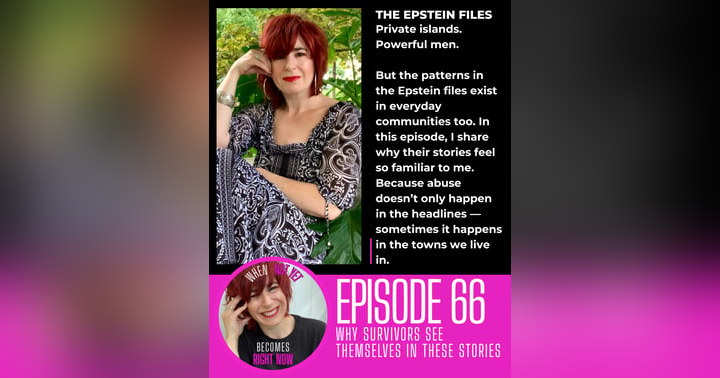
The Epstein Files: Why Survivors See Themselves in These Stories

Send a text This episode explores the harrowing realities of abuse, the importance of believing survivors, and the ongoing fight for justice. Jen shares personal experiences and insights into the systemic issues surrounding abuse cases, emphasizing the need for awareness and support. Key Takeaways: Systemic abuse and cover-upsPersonal survivor stories and traumaThe importance of believing and supporting survivorsEpisode Highlights: [00:00] Introduction to Sensitive Topics [04:07] The Reality ...


This episode explores the harrowing realities of abuse, the importance of believing survivors, and the ongoing fight for justice. Jen shares personal experiences and insights into the systemic issues surrounding abuse cases, emphasizing the need for awareness and support.
Key Takeaways:
- Systemic abuse and cover-ups
- Personal survivor stories and trauma
- The importance of believing and supporting survivors
Episode Highlights:
[00:00] Introduction to Sensitive Topics
[04:07] The Reality of Abuse and Grooming
[06:50] The Impact of Disbelief and Community Silence
[10:02] Understanding Complex PTSD
[13:02] The Ongoing Cycle of Abuse
[15:57] The Need for Awareness and Support
[18:30] Conclusion and Call to Action
Resources:
RAINN https://rainn.org/ - As the nation’s largest anti-sexual violence organization and operator of the National Sexual Assault Hotline, RAINN’s mission is to stop sexual violence by supporting survivors, holding perpetrators accountable, and creating safer communities.
Subscribe and Review Us on Your Favorite Podcast Platform:
Apple Podcasts: https://podcasts.apple.com/us/podcast/when-not-yet-becomes-right-now/id1767481477
Spotify: https://open.spotify.com/show/25eQxhfgLvdt3G9rY68AEQ?si=dc60122b6bc34484
Amazon Music: https://music.amazon.com/podcasts/2f6dece0-0148-4937-b33d-168b5aedf52a/when-not-yet-becomes-right-now
iHeart Radio: https://iheart.com/podcast/214320962/
Follow us on Social Media:
The When “Not Yet” Becomes “Right Now” Podcast: http://www.whennotyetbecomesrightnow.com
Instagram: http://www.instagram.com/notyettorightnow
TikTok: http://www.tiktok.com/@notyettorightnow
Facebook: http://www.facebook.com/notyettorightnow
Threads: ...

When Not Yet Becomes Right Now (00:00)
Welcome to When Not Yet Becomes Right Now, the podcast where we dive deep into the moments of transformation, the times when not yet shifts into right now and everything changes. I'm your host, Jen Ginty and this podcast is all about those pivotal moments in our life journeys. You know the ones, when the hesitation fades, when we take that first step, even if it feels like a leap. It's in these moments that growth and healing begins. Each episode will explore stories of resilience,
moments of clarity, and the sparks that ignite real change. From personal experiences to expert insights, we'll uncover how people navigate the complex journey we call life and come out stronger on the other side. Whether you're searching for that spark in your own life or just curious about how change unfolds for others, you're in the right place. We'll discuss the ups and downs, the breakthroughs and setbacks, and how to embrace the right now, even when it feels out of reach. Because sometimes,
The hardest part of the journey is realizing that the moment you've been waiting for has already arrived. So take a deep breath, settle in, and let's get started.
When Not Yet Becomes Right Now (01:11)
In this episode, I'll be talking about sexual abuse, grooming, disbelief, and community sharing. I'll reference the files connected to to Jeffrey Epstein and share parts of my own story from the 80s. If this topic is tender for you, please take care of yourself. You can pause, skip, or come back later. Your wellbeing matters more than finishing this episode.
Before we go further, take one slow breath in and a long breath out. Feel your feet on the floor. Notice the surface supporting you. Look around and name three ordinary things you can see.
I see a I see a picture on the wall. I see the light switch.
Remind yourself, this is the present. I am safe right now.
Okay, so I want to go back to a conversation we started earlier. I have previously recorded an episode about the Epstein files and we were waiting for them at that time. We were waiting to see what would be released, what would be confirmed, waiting to see if the truth would actually be out there, documented, guess, X-file style. There was anticipation and speculation.
There was hope that maybe this time the stories wouldn't be dismissed. And now a portion of the files have been released, not the way they were supposed to be, but there was something to see. People rushed to see who was involved, who flew where, who knew what. The settings felt surreal, like private jets, private islands, like these people were mega rich people and we never
feel like we can touch that kind of power, because that's what it is. It's power.
But you know, I don't even feel the need to focus too much on that. What I really want to do is I want to talk about the girls. Because while the world was waiting, survivors like me were anxious, bracing for the feeling of watching powerful men getting away with abuse again. And for a lot of people, this still feels distant, not close to home. It feels like exotic almost.
But for survivors, it's not distant. It's familiar. And what I need people to understand is that these girls and those files aren't characters in a TV show or a scandal. They're women like me.
People tell themselves this is different. That was on a tropical island, that was with the ultra rich. That's not something that happens around here. But abuse doesn't require a private jet. Grooming doesn't require being in a mansion. Silencing people doesn't require lawyers. It just requires power. And power exists in small towns too.
The setting was different, the dynamics were not. In those files, you read about a powerful man who gave attention, gifts, job opportunities, who made girls feel special. It didn't start with violence. it started with the idea that they could become someone else, someone who could be a star maybe. And that's how it started for them.
Here's where my situation is different. Not completely different, but my abuser was supposed to protect me from those sick pedophiles. Instead, he was the pedophile.
My father would tell me pretty much daily that I was fat and ugly and no one would ever love me. He made me feel so small. He especially liked to point out when there would be like a woman walking down the street that I would never look like her. I would never look like the women in TV and movies. He made me feel like he was the only person who was there for me, who could stand me.
honestly. So grooming is psychological. It doesn't care about time. It doesn't care about where it's done. It just cares that it happens. In those files, you see patterns, these girls being isolated, that what they were doing was normal and that they would just keep pushing it a little for them. I know there are stories of
some of these girls who thought they were just there to give a back rub. And then it turned into them having to touch a man in his privates. They barely even knew what those privates did.
Abuse often doesn't begin as something you recognize. It's something you end up surviving.
The news outlets are constantly asking why they didn't speak out while it was happening. Why didn't they just stop going to the places they were being harmed? The media made it easy to ask these questions because that story is so fantastical. In my life, it wasn't national media. It was people in my town, the people who knew my abuser and didn't want to believe it.
I used to walk to work every day. This is the late 80s, early 90s. It was still, I was walking 10 miles, and actually it kind of was. But I would walk to work and I would pass by this gas station that was down the street from me every day. And the owner of that gas station knew my abuser very well and didn't want to believe what we were saying he did. He just...
decided that my abuser was not that guy. So whenever I'd pass by, he'd yell out to me. He would say awful things to me. He would scream at me, you're a fucking liar.
And these girls also had powerful men calling them liars. I had members of my community, I guess, my town. Although the scale is different, the pain is similar because not being believed breaks you.
I wasn't believed during our court case, which lasted many years because I was 14 when this all came out. My brothers were older and they had words to describe what had happened to them. I was still so, so scared. I couldn't speak it. I wasn't ready. But when I was ready and I did speak my truth, I wasn't believed. The district attorney, ⁓
just thought that I was just adding on, because I wanted to be quote, a part of this. What child wants to be a part of a court case that talks about intimate details of abuse that they've had by someone who is supposed to protect them? I had to go in front of a grand jury and tell stories of what my abuser did to me so that I would be able to be
added to the trial. My story could be added to the trial. Not believed, just made to humiliate myself in front of a bunch of strangers. And these girls, these women, have also had to deal with going in front of strangers and telling their story. It doesn't matter.
that mine was in front of a small grand jury and theirs are in front of the media, it doesn't matter what scale it is, it's still public shaming.
The files show years of silence, years of people who just didn't say anything, quote, like looking away from it instead of seeing what was in front of them and taking action to help young girls.
The long-term impact of this kind of abuse is greater than I think anyone could ever truly understand. We live with complex PTSD. I'll explain to you what that means. ⁓ It was explained to me by a social worker in a really great way. PTSD, post-traumatic stress disorder.
is when you have had ⁓ something very bad happen to you. It's when something happens to you and you can't really respond in the way that your mind would want to, you get triggered.
⁓ Let's say you're in a car accident and after that you didn't want to get behind the wheel. You were afraid that you were going to crash your car into something again or someone was going to hit you out of the blue. And after a while you can work through that situation and then maybe get behind the wheel and drive again. Complex PTSD is when you are steeped in trauma, like you live trauma.
for long periods of time. homelessness is complex PTSD. War, complex PTSD. But so is childhood abuse and domestic violence. So complex PTSD lives inside your body and feels like you're constantly waiting for something bad to happen.
So that's what complex PTSD is. It's waking up some days, not having had anything really happen, but your brain feels as though something is wrong and you're hyper vigilant and you can't sleep and you don't feel safe. It changes trust completely.
I honestly have a very difficult time trusting and new people forget about it. It takes a long time for me to develop a relationship with someone. My nervous system goes haywire and I just feel like I need to hide sometimes. And my self-image went into the drain. Like I said, my abuser told me that I was fat and ugly and no one would ever love me every day, basically.
And these women also feel this low self-image. They don't trust. They have a hard time building relationships, right?
The stories that we hear from these women are triggering for survivors. It's not drama, it's seeing yourself in their story. And your nervous system remembers what your mind tries to forget, but it sits there and it gets triggered.
Now, these right now, as we speak, as I speak, not seeing much happen. We're seeing things happen over in Europe. mean, Andrew was arrested, not for the abuse, but he was arrested. And there have been other political people and heads of banks, different people out there in the world who have
had to leave their jobs, who got arrested for these things. But we're not seeing it here at home in the US. We're seeing the Department of Justice hiding information from us because they are protecting their ⁓ tyrant in chief.
They are trying the hardest they possibly can to make sure that people don't see what's to be seen in those files. But we have, and it's horrifying. And knowing that he's still running the country, starting wars, and just existing without consequence is horrific.
My abuser, a few years back, ⁓ was extradited from one state back to a state that he lived in because the granddaughter of his wife finally came forward with abuse accusations. And she did what I didn't have to do.
which was to go in front of a court, and talk about all the things that had happened to her. I had a small grand jury. She did this on the big screen, as far as I'm concerned. And after hearing all of the things that she had to say about this man, the judge actually said he was
the worst he could possibly think of. Imagine that, a judge thinking that he's so dangerous that he needs to go away, which he did. But then
the Supreme Court of the state.
her overturned his conviction because of a technicality. And seriously, this is a technicality. And that is what caused him to be let free.
As someone who was abused by this person, it feels fresh. It's scary to know that he's out there again. And I know that he is doing something. you know, I'm gonna tell you this, pedophiles don't stop being pedophiles. They will continue because they can't stop themselves. They will find the next victim.
which I'm sure my abuser found victims after me just like this girl, this granddaughter. And now he's free again. He's free to go out there and do it again. Just because Epstein was, I mean, I think he was murdered, but others say that he committed suicide.
I honestly don't believe that, but let's not get into conspiracies here. Just because he was taken out doesn't mean that it stopped. It means that someone else picked up the slack.
So these people who were abusing these children aren't just immediately they stopped and never did it again. They are compulsive and they feel they have to do this and they will, especially because these men are rich and they have the power to quote, make it go away. Let's not let that happen.
Let's not let that happen for the granddaughter of my abuser's wife. I can't imagine how she felt when she heard that the conviction was overturned. Can you imagine?
Don't let this continue. Don't stop talking about it.
My abuse happened in the 80s and early 90s. There were no headlines. I didn't have the public knowledge. People didn't read about it. I was just a girl who had been through a pain that no child should ever have to live.
I didn't need a tropical island for it to be real. I didn't need a billionaire for it to matter. I was a girl and I deserve to be protected just like they did.
So survivors aren't scandals, we're not talking points, we're not political, we're not conspiracies. We're women who were girls who needed protection and for someone to have noticed. And the next time you see a story like this, I hope you don't look at the powerful names. I hope you think about the girls. Not just the girls in these stories, the ones in your town.
The ones who you know and feel uncomfortable about and with. The one who may have even already told you about her abuse. And I hope you believe her and give her support.
Believe survivors, please. We're not trying to make headlines. We're not trying to get attention. We're trying to heal.
Before I end this, really want to do some grounding in case this has been a difficult episode and you're still holding on. Thank you for that. Thank you for listening and for hopefully better understanding that this isn't about headlines. This isn't about scandals. This isn't about rich men and islands. This is about survivors.
in general, the girls, the boys who have been through what they have gone through as well.
Okay, so I want to do this grounding before we close out here because I think we need to take a moment to settle. If this was a difficult discussion, I understand completely. So we're going to take a slow breath in.
and a longer breath out, press your feet gently into the floor. Notice where you are, where your body is. Notice that you are here, not in the past.
If this stirred something in you, reach out for support. You don't have to carry it alone. And if you need to hear it...
I believe you.
When Not Yet Becomes Right Now (22:04)
Thank you for joining us for this episode of the podcast. This show is produced by Phoenix Freed LLC, and I'm your producer, Jen Ginty. We hope you found today's conversation insightful and inspiring. If you have a story of your own about when a not yet moment became right now, we encourage you to reach out and share it. You can find more information about being a guest on our show at whennotyetbecomesrightnow.com. Remember, you are not alone on your journey.
whether it's a journey of healing, growth, or transformation. Every story matters. Thank you for listening, and we'll catch you next time with another inspiring episode.