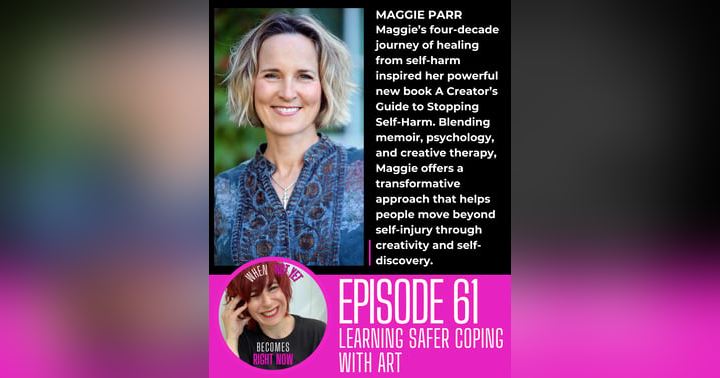
Learning Safer Coping Through Art with Maggie Parr

Note: This episode includes discussion of self-harm and cutting which may be distressing or triggering for some listeners. Please take care of yourself while listening. Jen speaks with Maggie, an artist and author, about her journey through self-harm and the transformative power of art in healing. Maggie shares her personal experiences with self-harm, the misconceptions surrounding it, and how she found solace and recovery through creative expression. The conversation delves in...


Note: This episode includes discussion of self-harm and cutting which may be distressing or triggering for some listeners. Please take care of yourself while listening.
Jen speaks with Maggie, an artist and author, about her journey through self-harm and the transformative power of art in healing. Maggie shares her personal experiences with self-harm, the misconceptions surrounding it, and how she found solace and recovery through creative expression. The conversation delves into the complexities of mental health, the role of vulnerability and the importance of understanding and supporting those who struggle with self-harm. Maggie also discusses her book, 'A Creator's Guide to Stopping Self-Harm', and offers insights on using art as a therapeutic tool for healing.
Key Takeaways:
- Maggie's journey with self-harm began at a young age.
- Art provided a healthy outlet for Maggie's struggles.
- Both men and women can struggle with self-harm, but men often don't report it.
- Recovery from self-harm involves understanding and embracing the parts of oneself.
- Shame often prevents open discussions about self-harm.
- Maggie's book aims to provide resources for those struggling with self-harm.
- Art therapy can be a powerful tool for self-discovery and healing.
Episode Highlights:
[00:00] Maggie's Journey: From Self-Harm to Healing Through Art
[10:21] Understanding Self-Harm: A Deeper Look
[16:02] The Role of Creativity in Recovery
[23:31] Art as a Medium for Connection and Healing
[27:42] The Book: A Creator's Guide to Stopping Self-Harm
Resources Mentioned:
Connect:
https://www.facebook.com/MaggieParrArt
https://www.instagram.com/maggieparrart/
https://www.linkedin.com/in/maggieparr/
Go to http://www.mymoodymonster.com to learn more about Moody today!
Subscribe and Review Us on Your Favorite Podcast Platform:
Apple Podcasts: https://podcasts.apple.com/us/podcast/when-not-yet-becomes-right-now/id1767481477
Spotify: https://open.spotify.com/show/25eQxhfgLvdt3G9rY68AEQ?si=dc60122b6bc34484
Amazon Music: https://music.amazon.com/podcasts/2f6dece0-0148-4937-b33d-168b5aedf52a/when-not-yet-becomes-right-now
iHeart Radio: https://iheart.com/podcast/214320962/
Follow us on Social Media:
The When “Not Yet” Becomes “Right Now” Podcast: http://www.whennotyetbecomesrightnow.com
Instagram: http://www.instagram.com/notyettorightnow
TikTok: http://www.tiktok.com/@notyettorightnow
Facebook: http://www.facebook.com/notyettorightnow
Threads: ...

When Not Yet Becomes Right Now (00:00)
Welcome to When Not Yet Becomes Right Now, the podcast where we dive deep into the moments of transformation, the times when not yet shifts into right now and everything changes. I'm your host, Jen Ginty and this podcast is all about those pivotal moments in our life journeys. You know the ones, when the hesitation fades, when we take that first step, even if it feels like a leap. It's in these moments that growth and healing begins. Each episode will explore stories of resilience,
moments of clarity, and the sparks that ignite real change. From personal experiences to expert insights, we'll uncover how people navigate the complex journey we call life and come out stronger on the other side. Whether you're searching for that spark in your own life or just curious about how change unfolds for others, you're in the right place. We'll discuss the ups and downs, the breakthroughs and setbacks, and how to embrace the right now, even when it feels out of reach. Because sometimes,
The hardest part of the journey is realizing that the moment you've been waiting for has already arrived. So take a deep breath, settle in, and let's get started.
Jen (01:09)
Hello and welcome to When Not Yet Becomes Right Now. Today's guest is Maggie Parr, an artist and author who has designed theme park attractions, painted murals and portraits, and written and illustrated books and comics for over three decades. Art making has also helped her recover from many forms of self-harming, and she now teaches others how to use creativity to break through blocks and achieve self-actualization. Welcome, Maggie.
Maggie (01:38)
Thank you so much, Jen. Nice to be here.
Jen (01:40)
Yes, yes. Well, let's get right into it. What is your origin story?
Maggie (01:45)
My origin story with regards to this book that I've written, A Creator's Guide to Stopping Self-Harm, is really about my lifelong struggle with self-harming through cutting and burning, starting at age four, and really finally finishing with it and healing in my late 40s. I have been an artist my whole life, as you said, and
I figured out somewhere along the way that this behavior that was so scary to me and to others had a healthy outlet in art making. I learned early on in my teens that when I would draw dragons and repetitive things like scales and patterns, then it took me out of myself and out of my suffering for a while. Later in my 20s when I was still struggling with it off and on, I was in therapy, I was...
at some point I got sober. I did everything I could to help my mental health, but this persisted, this behavior. And so I found out that when I painted, I would paint gesso on raw canvases and cut into the gesso with a blade and then paint red paint it to that as it was drying. And that helped to channel the behavior into something else that was healthier.
⁓ So I did that for a lot of my middle adult years, 20s, 30s, and then I was sort of in remission for a while. It wasn't an issue. And then I went through a very painful divorce and it came back in my mid 40s. And at the time, probably still, there was little to no information about older adults who cut themselves. It's still considered a young woman's...
disorder. There's not even a disorder in the diagnostic and statistical manual. It's considered an area for their study and not a lot of people know about it and certainly there's nothing available for older adults as I said even though statistically 5 % of adults do it ⁓ and almost equally men and women across countries, across socioeconomic backgrounds. All of this I learned much later at the time in my mid-40s as I was trying to figure out what was wrong with me.
I didn't have any resources, so I realized that art could help again. I read The Body Keeps the Score, which taught me a lot about how this trauma was in my body. I found a new therapist and started doing somatic experiencing. I finally left the relationship and I dove in deep into the childhood trauma that had caused all of this.
and into believing that I could heal and I could be done with this. And so I identified, worked with, and gave new voice to the parts of me, fragmented parts who were doing this self-harming as a way, as a voice on the skin. I read a great article titled A Voice on the Skin and realized that this was a creative way to...
bring me back to the origin of how this started and to finally heal what was lost. And the whole journey was creative, but along the way I would give that part of me a pencil or a pen and he would scribble. I would say he because his little tomboy. It was me as a little kid. He'd scribble, draw, write things, scribble out the words. And ⁓ I slowly, slowly integrated. I began doing art about the parts.
giving voice to the parts and ultimately as I got healthy, got into a healthy relationship, ⁓ built a new life, I realized I wanted to write this book because this is a book I wish I had had. Not only when I was young and struggling, but when I was in my mid-40s and had no resources or community to help understand. as we often do, I wrote the book I wanted to read and now I help other people. ⁓
People reach out to me from all over the world and they're struggling. I'm not a therapist, so I always recommend people work with a clinician, work with a professional. What I do is I offer hope, ⁓ guidance through my experience, a belief beyond a shadow of doubt that we can recover from and learn from the behavior and can lead us back into parts of ourselves that we're missing.
Jen (06:16)
Wow, it sounds like you created a beautiful therapy for what... Yeah, it sounds like you found your own modality in that sense.
Maggie (06:24)
In a way,
Yes,
yes. And I found that there is something called parts work. Richard Schwartz, believe, does internal family systems. My therapist and I stumbled upon it without that resource, but I'm so glad it's there. As often happens when we're creating a path, we find that other people are on similar paths and finding their own way through the darkness as well. And so I was happy to discover that that is out there.
⁓ Certainly I'm not the first person to learn that art can help with ⁓ recovery and improvement and post-traumatic growth, but along the way also read another great book, Your Brain on Art, which is about the neuroscience of art making and being in an artistic environment on the brain with neuroplasticity and healing centers of the brain that have been damaged by trauma. It's just fascinating. There's a whole new
called neuro arts that advocates actually prescribing arts as a art as a form of treatment part of a treatment plan.
Jen (07:37)
That's incredible and it's such a great resource. think people who don't really have a need to don't know how our minds work and how our brains are so ⁓ moldable that we can change pathways. We can create new pathways. And as you said, The Body Keeps a Score is a great book to learn about that as well. But this art book sounds incredible. ⁓
Maggie (07:48)
Yeah.
Yeah, your brain
on art and there's a neuro arts blueprint website. I don't have the address off the top of my head, but there is an institute that works on that and is dedicated to advancing that field.
Jen (08:18)
Well, I'll definitely put that in the show notes for sure. That's an incredible resource. And for internal family systems, I myself also use ⁓ IFS. Yes, with my therapist, she introduced it to me. And it has, over the years, been a great tool to be able to better understand the parts of us that are hiding, the parts that are out there, but we don't understand them. And it's become an amazing source for me.
Maggie (08:27)
⁓ great, great.
Yeah, yeah, and so much of ⁓ mental health, and again, I'm a huge fan of therapy and my therapist and the field of psychology and psychiatry, but so much of it is geared towards identifying and treating pathologies. And those of us who have been on the receiving end of much of that for much of our lives, as I have been, I needed a creative, almost shamanic approach.
to a spirit guide, to spiritual parts of me, and I don't mean spiritual in the sense that they aren't material. I don't have my little eight-year-old standing next to me, but I feel my parts inside. So in that sense, it's a spiritual journey. I needed more of those resources and creativity to me is the way in. It's a way into our imaginations, our storytelling, and parts of me that I had a hard time with, I was able to embody and love.
through creative visualization, creative, drawing them. And I work with, the people I work with for the most part are not artists, but they can always, you can always draw a stick figure. Even though people say to me, when I tell them I'm an artist, most people say, I can't even draw stick figures, which is not true, but we've been shamed out of it by identifying who's an artist and who's not, but we all have a human instinct toward creativity. And it's not just.
Jen (09:54)
true.
You
Maggie (10:10)
drawing and writing but it's making connections in our brain. think creativity is about connections, neural connections, connections with other people, connections with ourselves.
Jen (10:21)
I absolutely agree. Can we talk a little bit more about self-harming? You had said that there isn't a diagnosis in the DMS, DSM.
Maggie (10:23)
Yeah.
No,
DSM-5 there is not. mm-hmm, no, it's considered a behavior, not a diagnosis, which I understand because I don't think it's a diagnosis. I can't see it as that because it's, it's a symptom to me. It's a voice. It's something trying to be heard. Um, sometimes it's associated with people who have borderline personality disorder. And I say that in quotes because that's, um,
Jen (10:33)
That's incredible to me.
Maggie (10:59)
a sort of controversial diagnosis often used mostly against women. ⁓ But it is still out there and that's a different kind of, a different reason for cutting than those of us who do it because of trauma. What happened to us as little kids removed our ability to voice how we felt to talk about what was happening.
And so this becomes a visceral, even addictive way to release ⁓ pressure. It's actually not suicidal for the most part. It may lead to suicide attempts later, but the act itself is about releasing pressure on bearable emotions and soothing. It's a self-soothing behavior.
Jen (11:46)
⁓ My first time ⁓ being introduced to self-harm, I was 14. My whole world had just blown up. My abuser was taken from our home and I needed help in going to a hospital. And my roommate, she self-harmed and she had said the same thing to me because I did, asked her, was like, why do you do this to yourself? And she said,
I need to take what's in my brain out and put it somewhere else to relieve the pain in my head and the thoughts that I have. it's so interesting how our minds can turn to self-harm in many different ways, right? It can be physical, but we also do it emotionally to ourselves as well.
Maggie (12:19)
Mm.
Yeah.
Yeah.
Yeah. Yeah.
Right.
Jen (12:44)
And you slept.
Maggie (12:45)
Animals do it as well. Animals do it. ⁓ Apes, chimps in laboratory settings, medical testing settings where they are very unhappy will chew themselves, they'll bite off fingers, they'll do all kinds of terrible things when they feel, it seems to be this feeling of being trapped and unhappy at the same time. So you can't express it in any way. Dogs do it when they're unhappy, they harm themselves. So we're not the only species that does it. It seems to be an
⁓ natural reaction as unnatural as it seems it's when we don't feel we have any other choice.
Jen (13:19)
So you also said that it's, I absolutely thought that this was mainly a female ⁓ disorder, that women and especially like you said, young girls are the ones who self-harm and, but men also self-harm?
Maggie (13:29)
Yeah.
Mm-hmm.
Yes, yes. In fact, when I was in high school, a few of us were doing it and one of them was a man and I've met in the sober community, I meet a lot of men who have struggled with it in different times. ⁓ They don't self-report it as often. So it's not, it's not statistically counted as much. So that's why in terms of self-reporting and clinician reported something like over 30 % of the people who self-harm are male, but that's most likely under-reported because males don't.
report as often. And they tend to be, they include more behaviors like violence against the self, not always this controlled cutting that is done, but a lot of men cut as well. And that's another thing that's not known. Just like we didn't know 20 years how many men had been sexually abused as boys.
Yeah, so it's a really neglected field of study that I would like to see studied more and tied to what happens to us as children.
Jen (14:34)
Yeah.
Yeah, you know, it's interesting to me that with what happened in my childhood that I didn't do that and some people do and some people don't. Is it a trigger, like a certain trigger that will start someone self-harming?
Maggie (15:03)
I honestly don't know the answer to that. ⁓ For me personally, I read a novel that had self-harming in it, but not the type that I adopted. I don't remember ever hearing about how I ended up cutting myself, but my cousin on my mother's side ironically did it too, and she assured me that she hadn't seen mine and gotten the idea from me. And she also, unlike me, was not sexually abused as a kid. that's not always a causative factor.
But I just wonder sometimes if there's ⁓ a genetic element in there because it was so unusual that we both did it for a while for different reasons, but for the same results of soothing.
Jen (15:41)
Yeah, because people don't talk about it often, mean, it feels like it's that secret, that thing that you hide away for shame. ⁓ So it's so important to bring it to light and to let people know that it's not one in a thousand. It can be quite common.
Maggie (15:46)
Yeah.
Yeah.
Right.
Right, actually, when I was doing, looking at the statistics from the National Health, mental health sites, I applied it to current demographic numbers and realized that in the US alone, there's about 14 million people who are doing it, children and adults, not just teenagers, but even pre-teens. So like I said, I started at four and I'm not the only one who started that young.
Jen (16:28)
Yeah, and that it can go throughout to adult populations. You had said that you stopped at one point. ⁓ Was there some sort of modality? said your creativity helped with that.
Maggie (16:34)
Yeah.
Yes.
Yeah, in my 30s I stopped for maybe 20. And when I mean stop, ⁓ I mean stopping the obsession. Like there were times when I would white knuckle through and just not do it because my partner at the time really didn't like it and would let me know. It was very frightening and would upset her very much. And so ⁓ I managed to willpower my way through it for many years. And
It worked. mean, I discovered I can use my will. But the problem with that is that I wasn't truly healed inside. I was controlling the behavior and calling myself recovered when in reality there were parts of myself I was still afraid to visit. so that I wouldn't have done that work if I hadn't if my life hadn't fallen apart and I had no choice. Wasn't like I was virtuously searching out. I was just like, oh, my life's falling apart. I had to move out of my house into this little
pink room, my friend's daughter's old room, it overlooked an alley. Crying for 15 months just like, ugh, so I had to look at it and see what was wrong before I continued with my life.
Jen (17:56)
There's the right now moment, right?
Maggie (17:59)
Yeah, the right now, it's like either now or never and I have to live my life. And once I really went in with the attitude of surrender and I want to find why I'm doing this, not just stop the behavior, but love myself. I was tired of hating and hurting myself being my first go-to when I was under stress. And that was the moment in that pink room crying on the floor. I was just, can't do this anymore.
Jen (18:26)
can only imagine how taxing it was to will yourself to not do something that felt so soothing and helpful to you. It's interesting to me that ⁓ you can function.
Maggie (18:35)
Yeah. Right.
Jen (18:46)
when you're not giving yourself that soothing, no matter how destructive it is.
Maggie (18:51)
Yeah.
Yeah, I I would do all kinds of other things. Some of them healthy, some of them not. mean, some over-exercising. As I said, I got sober, so that wasn't an option. Being very anxious, obsessing. I also resisted medication for many years. I had judgment about it and fear about it. So I didn't go into depressants until after I moved out from this relationship, and it finally helped quite a bit.
I would also meditate. learned meditation, I did yoga, I went to therapy, I tried everything I could. tried eating healthy, know, anything to control the feelings. And ultimately, the only way around it was right through the middle. And so, my life cleared away. Everything just cleared away with this breakup. And I just went to it.
I moved out to this little room with my bag, my computer, and a couple of books and just did the work.
of going inward.
Jen (20:03)
For those of us who have complex PTSD, we go into hyper modes, right? So, yeah, there's the, I can imagine you said you were like hyper ⁓ vigilant with it. it's interesting that I don't think a lot of people truly understand that hyper mode that people have when they have complex PTSD.
Maggie (20:09)
Yes.
Yeah, it's that feeling of always being on. mean, I'm not, I don't think I'll ever be completely over it in the sense that I still sometimes wake up at three in the morning panicked. I, ⁓ nothing like I used to. I still tend to overwork and I have to take breaks and, ⁓ it's always a work in progress. The difference now is that I'm not driven by trauma and through, through finding compassion for myself by reuniting with the child parts.
and listening to what that part, cutter part of me was trying to say is that I'm in the present. I'm in the present as a whole person who sometimes struggles with the after effects of trauma, but I'm not, it's not my whole world anymore. I'm not unconscious about it. I'm not harming myself. ⁓ It was a huge sea change and writing this book, thinking of how to serve others with my experience was what really
turned it around because every time I share with someone else how I got through it, I realized that I'm through, I'm through. You can come too, come this way. And it's hard in the meantime, I know it's hard. And I have compassion for people being in that hyper mode or being in that triggered mode. Like I'm good with holding the space for someone, I'm not afraid of it. ⁓ I don't have to make it go away or make them better. I don't have to tell someone, stop cutting yourself, because I know it's soothing.
and you'll stop when you're ready, when you don't need to anymore, and I'm not gonna judge it or shame you.
Jen (22:00)
Yeah, I feel that shame component of it is when we do anything to ourselves. Yeah, when we do anything to ourselves, when we talk poorly about ourselves to ourselves, you know, it's, there's that shame factor of why I don't want anybody to know that this is happening, that I'm not, as my mother likes to be, like, it's better to look good than to feel good, right?
Maggie (22:12)
Mm-hmm. Mm-hmm.
Right.
⁓
I saw an acronym for shame this morning. ⁓ Should have, what is it? Should have already mastered everything. Like I'm supposed to know, and if not, I'm ashamed because I don't know, but none of us know. I mean, we're all like these, we all have trauma and things go on and we don't know how to do things. No one knows how to do anything. We only learn by doing it. In fact, we learn through making mistakes. And so few of us are taught.
Jen (22:35)
Ooh.
Maggie (22:53)
to be okay with making mistakes, screwing up and ⁓ doing the wrong thing, hurting someone, hurting ourselves, then we learn how not to do those things. Like we don't look at a little kid stumbling on the ground and say, get up you dummy, because he fell. We say, it's okay, it's okay, come on, try again. And if we could have that attitude our whole lives, there'd be a lot less shame.
Jen (23:17)
I wish. If the human mind could just adopt that, you know, that's the one thing I would want. Yes, that we would have that in our minds, that there is no such thing as perfection.
Maggie (23:18)
Yeah.
Yes, or be taught that,
Right.
Mm-mm. Mm-mm.
Jen (23:31)
So tell me about your art.
Maggie (23:35)
I have so many branches of it, but my favorite description of my art came from a friend of mine who said, Maggie's art is like, oh, oh. I have two different branches. I have the Disney stuff, designing theme parks. I designed a carousel in Shanghai Disneyland. It was my favorite project. Painting characters and famous artworks. And then I have
Jen (23:47)
Hahaha!
Maggie (24:00)
more of these like other pieces like behind me that are a lot more. I mean, these are the more cheerful ones, but I've done a lot of pieces that are very, very expressive, very not Disney, very personal and often confrontational. As I was going through a lot of the work, I would do very kind of dark, painful things because I needed to get it out and I allowed myself that freedom. But that's the mostly oil painting.
Jen (24:09)
yes.
Maggie (24:28)
lot of designing and illustration and now I'm doing a lot more teaching. I'm enjoying that quite a bit. As a result of writing this book and helping others, I realize I enjoy that process of sharing my gifts with other people.
Jen (24:41)
And when did you realize you had a book inside you?
Maggie (24:46)
⁓ I always wanted to write this book, but I was afraid. Again, the shame about letting people know. I could count on one hand the number of people who asked me what the scars were on my arms. It's just like they were right out there in the open and people wouldn't say anything or they would think it was because of the treatment for diabetes, ⁓ the scars, ⁓ dialysis scars or something, or I was in an accident and I would be afraid to tell people.
Jen (25:11)
⁓ yeah.
Maggie (25:15)
even though I still would kind of leave the scars on my arm. ⁓ But I realized I was ready about, well not about, was exactly two years ago around this time when I applied for a job sort of as a ⁓ semi counselor and I didn't get the job, and I was disappointed at it, but then I realized, I'm an artist, why am I applying for this? Because I have always wanted to help people with mental health issues. And how does that fit with my art?
And then I realized that my art has been part of my mental health this whole time. And that's when I read Your Brain on Art and I started realizing that this could help other people. And actually in these last two years, I have finally gotten tattoos that cover up the scars. Let me see if I can pull this around. that's partly mine, but it's mostly a...
Jen (26:04)
it's beautiful, is that your art?
⁓ gorgeous.
Maggie (26:14)
an artist named Alexis Dedicated, he's over here in Sonoma, California. He and I became friends through a long story, but we became friends through my helping him get some art in a show. And I traded oil painting lessons for these tattoos, and we just became really good friends. And he also had a tough background, and art saved his life. ⁓ So that's one of the many gifts of ⁓ being of service.
being connected to other people and being honest about who I am. He didn't once when I mentioned that I needed to sort of frame these scars in the artwork. ⁓ So once I find that we always respond and connect to and connect to people who are vulnerable, but we don't like to be vulnerable ourselves. But that is the currency of intimacy and true connection. And so I have found that now that I am completely open about my past and framing it in the service of helping others.
It empowers me and it empowers my voice that I've been looking for all this time.
Jen (27:19)
That's wonderful. And by the way, listeners, this is an interactive episode. Go over to YouTube or Spotify. It'll have it on there. You have to see, yeah, you have to see Maggie's art. You have to see her tattoos. They're incredible. So just that little extra something. is there a, yeah, is there a flow to the book? Does it go in a specific direction?
Maggie (27:25)
You see the images.
Well, thank you.
Yes,
I give the overview and introduction and I do some grounding work that helps just like a somatic experiencing. We start with creating a safe space and grounding. I do that in the book. I give different exercises, not just drawing, but also breathing, butterfly tapping and different things. And then I the rest of the chapters are structured around each part. So I renamed the cutter Faith. So Faith is the tomboy who is doing the cutting, who is trying to protect me.
protect the littlest one named Hope. And the teenager is Love. She, well, that's her real name, her secret name, and she goes by Elle. And then Grace is the one who contains all of us. So the four chapters, Faith, Hope, Love, and Grace, are about the steps on the journey toward healing. And it's a spiritual journey. It's partly a creative journey. It's an intellectual journey. ⁓ It's an emotional one, so.
I structured around my parts since they're the ones who showed me who we are.
Jen (28:48)
beautiful and so intimate of you to be able to give that to your readers. It's very special. Now when you work with someone with you know to help them to use art, how do you go about that? How do you start that?
Maggie (28:53)
Thank you.
It depends obviously on the person. And if it's in person or online, I've been talking to someone in England. So that's obviously through texting and some Zoom and calling. I have a friend whose daughter was struggling. So she would bring her daughter over to the house and we would talk in my studio. ⁓ So it really, depends on where they are. It starts with grounding exercises and then.
suggestions about what to draw. And then also an important thing is getting holding the space for witnessing what's in the drawing. Because a lot of times when you ask the part of someone who's cutting or burning to draw, it's going to be a very disturbing image. And so I want to hold the space for that, not judge, but just love what comes out and thank them for what they've shared and notice any things that they didn't notice, perhaps.
Encourage them to keep doing something like that when they feel like cutting and then when they do relapse ⁓ Talking with them about what what happened or what what was that part trying to say not about shaming like why did you do that, but How can how can you be okay with having done that and maybe learn from it or listen still listen to what that part was trying to say
Jen (30:31)
Have you ever seen someone else's art and thought, wow, that's very personal to me as well?
Maggie (30:40)
Someone else's art. I can't think of anything right now. I think that's the thing and why my art often doesn't fit in galleries and public because it is so personal and intense. ⁓
I mean, oddly, Honolour Barron's work, she was a child during the Holocaust and did these little box assemblages and they just looked like a little child who was dealing with ⁓ the violence and the things that happening during that time. She wasn't in a camp, but she was in a ⁓ ghetto, believe, when it, she went through a lot of ⁓ trauma around that. And something about her piece has always spoke to me even long before I knew why.
but in terms of the type of art I do, I haven't seen anything like it. It doesn't mean it's not out there, I just haven't seen it.
Jen (31:33)
when you work with someone and you're looking through their own artwork, do you ever say, wow, that what you did right there? Yeah, yeah, no worries. But yeah, yeah, yeah.
Maggie (31:41)
Yes, that's what she meant. Yes. Yes. Okay.
Well, yes, actually it is fascinating to me how somebody's ⁓ non-artists, their little kid drawings when they do have a lot of similar symbols and images as my drawings did. Also the very, very similar words too. Not just know, but know and stop, but all kinds of other things that really bring out the child's reaction to trauma. But a lot of use of red, a lot of use of zigzag lines. ⁓
And I don't know, it's just, it is fast. A lot of triangles, like I always use triangles and a of the people I've worked with draw triangles a lot of the time. So yeah, that is fascinating to me how people, there is a, just like there's a, to be like perpetrators share a guidebook on what you do and say. I think those of us who are victims as little kids.
also share human responses that have more in common than not.
Jen (32:42)
Yeah. Okay, mental health professional, you need to study this. Why people who self-harm do similar symbols, that kind of thing. Because I think that that could be, and could it be an insight into how to help others?
Maggie (32:47)
You
Maybe I would think so. I would love to work with clinicians. That's one of my, I'm so busy I haven't been able to do as much of this on this as I want, but I put up a website, stoppingselfharm.com, and as part of that, my next step is to do a series of videos. One for people who struggle, another for their families so they can understand better, and then a third for clinicians, because I've done a lot of research. Not only research of being a client for therapists.
I've also researched, as you can probably tell, a lot of the statistics, the approaches, the modalities, the diagnoses, and ⁓ I have some opinions or input on what's more effective, what things don't work so well.
Jen (33:45)
Well, I think that it would just be an incredible study because this is one of those invisible things that need to be out in the open where people can talk about it. You know, there's not shaming a person for harming themselves, but saying, can we do to help you through this?
Maggie (33:53)
Yeah.
I think so.
Yeah, how can I help? What happened to
you? What are you trying to say by that?
Jen (34:12)
Yeah, and those questions are important, and I can imagine that those are the questions that you use with the people you work with.
Maggie (34:20)
Yeah, and that's what my therapist used with me. And I'm so grateful to have that, have had someone who guided me through all of this. And if I can give a little of that to others as a non-therapist, then I would be happy.
Jen (34:35)
What advice would you give to someone who wants to discover more about using art instead of self-harm?
Maggie (34:50)
I mean, you could get my book. That's a part of it. You could get your brain on art. Yes. Thank you. I would definitely read your brain on art and the body keeps the score. If you're going to pick two books, those would be two. And then I would say, try it. Try drawing. Who is doing the self-harming? If you're not cutting, you're just maybe mean to yourself in your head or you're overeating or something that you wish you didn't do. Go inside and
Jen (34:52)
That's A number one.
Maggie (35:20)
Try and find who is doing that thinking or that behavior and embrace them, get to know them, ask them questions. What is this about? What is it that you need that you're not getting? What are you trying to say? Can you draw a little picture of yourself? Can you draw what it feels like to be you and let yourself be a little kid drawing without any judgment?
And you'd be surprised, I've worked with a lot of people who are not artists who do this and they're always surprised by what comes out because the kid is there. Just because we grew up doesn't mean that's dead, you know? A lot of times they're just waiting to be seen and heard in a way that they never were.
Jen (36:00)
Yes. So Maggie, where can we find you? The book, your art, everywhere. Where can we get you?
Maggie (36:05)
We should.
Yeah, thank you for
asking. If you look at Maggie Parr, ⁓ you'll see a lot of my artwork online. You can go to maggieparr.com. That's my art website. And again, stoppingselfharm.com is the website I created for the book. The book on Amazon is a creator's guide to stopping self harm. And on the website, are links if you wanted to schedule a free consultation with me. ⁓ If I can help in any way, I will. ⁓
and start exploring. Start exploring to see what works for you. And I'm always happy to give feedback or look at someone's drawing or I'm always happy to help.
Jen (36:48)
Wonderful. Well, thank you so much, Maggie. This was such a great conversation to, I think that self-harm is a topic that is not discussed enough. And my listeners got a good perspective and understanding through you. So I thank you for that.
Maggie (36:52)
Thank you.
I hope so.
Thank you so much. It was a wonderful interview. I appreciate it.
When Not Yet Becomes Right Now (37:15)
Thank you for joining us for this episode of the podcast. This show is produced by Phoenix Freed LLC and I'm your producer, Jen Ginty. We hope you found today's conversation insightful and inspiring. If you have a story of your own about when a not yet moment came right now,
We encourage you to reach out and share it. You can find more information about being a guest on our show at whennotyetbecomesrightnow.com. Remember, you are not alone on your journey, whether it's a journey of healing, growth, or transformation. Every story matters. Thank you for listening, and we'll catch you next time with another inspiring episode.