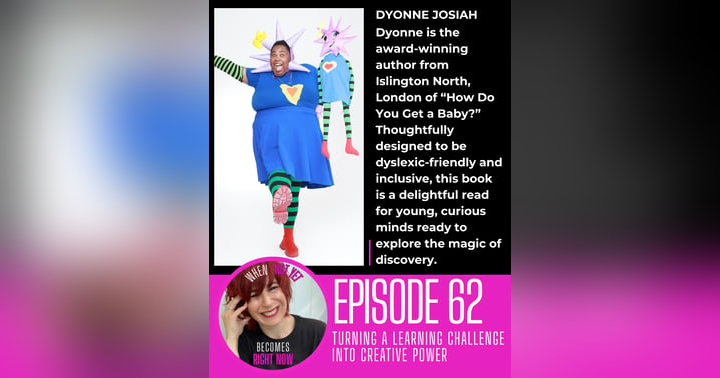
Turning a Learning Challenge Into Creative Power with Dyonne Josiah

Jen speaks with Dyonne Josiah, an award-winning self-published author, about her journey from struggling with dyslexia to creating an inclusive children's book. Dyonne shares her experiences with negative educational encounters, the importance of supportive figures in her life and how she transformed her challenges into creative expression. The conversation highlights the significance of representation in children's literature and Dyonne's commitment to inclusivity through her ...


Jen speaks with Dyonne Josiah, an award-winning self-published author, about her journey from struggling with dyslexia to creating an inclusive children's book. Dyonne shares her experiences with negative educational encounters, the importance of supportive figures in her life and how she transformed her challenges into creative expression. The conversation highlights the significance of representation in children's literature and Dyonne's commitment to inclusivity through her characters. She also discusses her future projects and the personal growth she has experienced through writing.
Key Takeaways:
- Dyonne's journey reflects the power of resilience.
- Supportive figures can significantly impact one's path.
- Dyslexia can present unique challenges in education.
- Inclusivity in children's literature is essential.
- Representation matters for children with disabilities.
- Dyonne's book encourages exploration and curiosity.
- Family support is crucial in pursuing one's dreams.
Episode Highlights:
[02:49] Dyonne's Creative Journey and Background
[04:13] Impact of Teachers on Dyonne's Life
[11:00] The Role of Family Support
[13:03] Understanding Dyslexia and Its Challenges
[19:18] Inspiration Behind Writing the Book
[22:04] Overview of 'How Do You Get a Baby?'
[23:41] Inclusivity in Children's Literature
Resources Mentioned:
Dyonne’s Website https://canaryryland.com/
Dyonne’s Book https://canaryryland.com/product/how-do-you-get-a-baby/
Connect:
https://www.youtube.com/@canaryanddyonne
https://www.instagram.com/canarysadventures
https://www.tiktok.com/@canaryryland
Go to http://www.mymoodymonster.com to learn more about Moody today!
Subscribe and Review Us on Your Favorite Podcast Platform:
Apple Podcasts: https://podcasts.apple.com/us/podcast/when-not-yet-becomes-right-now/id1767481477
Spotify: https://open.spotify.com/show/25eQxhfgLvdt3G9rY68AEQ?si=dc60122b6bc34484
Amazon Music: https://music.amazon.com/podcasts/2f6dece0-0148-4937-b33d-168b5aedf52a/when-not-yet-becomes-right-now
iHeart Radio: https://iheart.com/podcast/214320962/
Follow us on Social Media:
The When “Not Yet” Becomes “Right Now” Podcast: http://www.whennotyetbecomesrightnow.com
Instagram: http://www.instagram.com/notyettorightnow
TikTok: http://www.tiktok.com/@notyettorightnow
Facebook: http://www.facebook.com/notyettorightnow
Threads: ...

When Not Yet Becomes Right Now (00:00)
Welcome to When Not Yet Becomes Right Now, the podcast where we dive deep into the moments of transformation, the times when not yet shifts into right now and everything changes. I'm your host, Jen Ginty and this podcast is all about those pivotal moments in our life journeys. You know the ones, when the hesitation fades, when we take that first step, even if it feels like a leap. It's in these moments that growth and healing begins. Each episode will explore stories of resilience,
moments of clarity, and the sparks that ignite real change. From personal experiences to expert insights, we'll uncover how people navigate the complex journey we call life and come out stronger on the other side. Whether you're searching for that spark in your own life or just curious about how change unfolds for others, you're in the right place. We'll discuss the ups and downs, the breakthroughs and setbacks, and how to embrace the right now, even when it feels out of reach. Because sometimes,
The hardest part of the journey is realizing that the moment you've been waiting for has already arrived. So take a deep breath, settle in, and let's get started.
Jen (01:10)
Hello and welcome to When Not Yet Becomes Right Now. Today we're joined by Dyonne Josiab, an award-winning self-published author from Islington, North London. In October 2022, she released her debut children's book, How Do You Get a Baby? A fun and heartwarming story for readers five and up. The book follows six-year-old Canary Ryland as she embarks on a curious adventure, asking her friends where babies come from.
and receiving some truly amusing answers. Thoughtfully designed to be dyslexic friendly and inclusive, this book is a delightful read for young curious minds ready to explore the magic of discovery. Welcome Dyonne.
Dyonne Josiah (01:56)
Thank you so much for having me. I'm excited to be here.
Jen (01:58)
Yes, yes.
Yes, we were connected by a former guest of mine. And I'm so excited that he connected us because I can't wait to get into our conversation. So yeah, so tell me, what is your origin story?
Dyonne Josiah (02:13)
yummy
Wow, okay. So as you mentioned before, I'm from an author from Islington, North London. I wrote this book called How to Get a Baby, because that question always comes up with children and their parents. And I wanted to kind of create a platform for them to explore that question in a kind of fun and non-judgmental environment, and just to have fun whilst reading my book.
Jen (02:49)
⁓ So tell me a bit about ⁓ your background, ⁓ your story as you were growing up.
Dyonne Josiah (03:01)
Sure. I, well, first of all, I found out I was dyslexic when I was 16. So I kind of went through pretty much most of my school life not knowing that I, you that I was dyslexic and I kind of struggled a little bit with reading and writing and, you know, kind of like basic stuff. But I always kind of just pushed forward ahead. And, you know, I want, and I always believed that
I could do it, even though it took me a long time to actually finish a book or write a paragraph. always believed that I could. I come from a creative background. My mom, she writes poetry and she writes songs. My brother is a musician and a producer. My sister-in-law is a singer. My cousin's a singer.
The list goes on, my other cousin's a rapper, my cousin's a dancer. So, you know, I come from a creative background and, I'm an author. I also am as an actor as well. So that's also my beginnings. ⁓ And yes, I think that's me in a nutshell.
Jen (04:13)
Now when we spoke, when we first spoke, we discussed ⁓ what was that right now moment for you. I know that there was ⁓ a teacher that had been very hard on you. Can you talk about that?
Dyonne Josiah (04:25)
Hmm. Yeah,
sure. Yeah. So, wow. It's weird because it was happened such a long time ago and sometimes it still kind of sits with me when I speak about it. But I kind of see it as like my power story. So when I was around seven or eight years old, as you know, like I said, I come from a very creative background. So I used to love drawing pictures and like doing lots of different colours.
And I I had this folder and this folder, this was just to put our work in. And the teacher said to us, just write your name ⁓ and the subject of the project that we were doing. She didn't say anything else. So I didn't think anything, you know, didn't think she wouldn't mind. So I decided to do a colourful border ⁓ just around the folder. And I got a lot of praise from my friends and they were like, wow.
Dyonne this is amazing. It's just stunning. And I was like, oh, thank you so much. was really chuffed by that. So I handed it in to my teacher. And when she was going through all the folders just to check that everything was right, she stopped on mine. And she called me over to the desk and she was like, Dyonne, what is this? And I was there with big smile on my face. And I was like, it's my work. And she was like, her face went completely.
neutral and she was like no what is this and then I was like ⁓ I can see in her face that she wasn't happy and she literally said to me this is not what I want and she took the folder ripped it to pieces and threw it at me and said to me to do it again it broke my heart and I remember going back to my desk and sobbing my eyes out I was just crying
so hard. I had to redo my name again just in black ink and just a nice, you know, that was a really long time ago in primary school but I still remember it as, you know, as like for today, and I didn't know at that moment what that meant but as I got older, thanks, you know, thanks to, shout out to my mum, she always encouraged me to
keep creating, to keep drawing and to keep, she never stopped me. So I take in my book and I felt like this is like a 360. I've taken that negative energy and I put it into my books and I'd be like, it's kind of a look at me now type of thing, for what my teacher had did to me at that time. And to do that to a child.
know, sometimes we, we forget that our, teachers are meant to be our heroes and at that moment she wasn't to me. Yeah, so I remember just, like I said, I was crying my eyes out and, I was really heartbroken that that happened. But thank you, like I said, thank you to my mum for encouraging me to keep writing and now I have an award-winning children's book.
Jen (07:39)
Yes, it's wonderful. You know, I have had past traumas from teachers as well. And I tend to say not everybody should be a teacher. You know, like if you can't support every single child in your room, then what are you doing being a teacher? Why would you spread negativity to a child who
Dyonne Josiah (08:03)
course.
Jen (08:08)
is showing an immense creative mind, right? Why would that be a negative for any teacher? I know if I saw that, I would just be so happy to have a splash of color and some pretty pictures that I could look at while I'm grading papers, that kind of thing, but...
Dyonne Josiah (08:13)
Yeah. Yeah.
Cool.
Yeah.
Jen (08:35)
Some teachers are just very no-nonsense and they just don't want you to stray from their path when of course they should be encouraging our own paths, right?
Dyonne Josiah (08:48)
Absolutely. Yeah, you're absolutely right. And, you know, to echo that on the flip side, I had some amazing teachers as well. There was one teacher called Miss Jones when I was in primary school. there was a, as was not long after that situation happened, we got a supply teacher and she was this.
bright sunshine of energy and she made me want to love being at school and she taught us music. I remember she taught us this song about birds and we got out some instruments and we were playing them and she was my favourite teacher and she was also a teacher who looked like me as well.
And I remember her crying again when she left and I was begging her to stay. was like, please don't go because that's how much of an impact she had on me. And again, I was only eight and she just brightened my day every single day for those two weeks that she was a teacher at my school at the time. You know, so even though I had that negative from my from my normal, you know, form tutor,
at my primary school, I had a little bit of a light with that teacher who was, she was so positive and she just exuded beautiful light and energy and I wanted her to stay and I've had so many of those people throughout my life as I've grown up. So yeah, so I've kind of had like, I don't wanna say the best of both worlds, but I've had an experience of both worlds, should I say.
Jen (10:31)
Yeah, and that's wonderful to hear that positive experience against that negative one. Yeah, those are the teachers that we need in this world, right? Not only can they, we obviously need teachers that can teach us exactly what we're supposed to be learning, but also teaching us kindness, respect, self-respect, those kinds of things that I think aren't really looked at.
Dyonne Josiah (10:40)
Yes. Yes.
Yeah.
Jen (11:00)
So I'm so glad that you had that wonderful teacher as well, even just for those two weeks, right? So tell me more about your mom. Tell me about her, you know, her place in your life.
Dyonne Josiah (11:05)
Yes, thank you. ⁓
wow. My mom, my mom, she... ⁓ You know, she is in my rock. She has been my light, my joy, my energy, know, everything you can ask for, for a mother that's been her, from the day I was born, should I say, She always knew who I was on a deeper level.
and you know, with teenagers and, mums, you always kind of have like your little tiffs, here and there, but it's never been anything serious between us. just a teenage, a little teenage rebellion, should I say. ⁓ But we're super close, and she just, she's, she's never once said to me, as I've gone into an adult, she's never once said to me,
Don't you think you're a little bit old to be doing drawings and, you know, drawing, like writing about stuff for children and doing colourful. She's never, ever said that to me. She's actually said to me, why are you not drawing pictures? I need to see more, So she's just been that massive encouragement that I've always needed. And I think it's really important. And if I don't call her every day, she's messaging me saying to me, why have I not?
Well, I have a lot of giving her a call, you know, and I see her quite often as well. So we are very, very close. And, it's just, it's me and my brother and she's a rock before both of us.
Jen (12:54)
⁓ that's beautiful. Growing up with an undiagnosed disability can be very, very difficult. I can only imagine that it was a very hard time getting through school, especially since you didn't learn of it until you were 16.
Dyonne Josiah (13:03)
Yeah.
Yeah, yeah, my mum always knew something was up from when I was really young. She knew that I wasn't as academically faster like the other children in my classes. She never, she never like forced me or like said, you know, you have to get like high grades and that she just always said, go at your own pace, which was really helpful for me. So I didn't always worry about.
having to be, I guess, perfect and having to get like top grades, even though that's what I wanted. So I would push myself. But yeah, so from, yeah, from when I was young, I just, I always knew that there was something wrong. I didn't understand why I was, you know, missing out sentences when I was reading or why when I was writing words that I would change the letters.
which I didn't mean to. So there was different things like that and my understanding was a little bit slower. And the more I researched dyslexia, the more I understood, I resonated with what I was seeing. I was like, oh, this makes sense. This understand why I'm like this, why I think this way or why I take a little bit longer to understand. Or even with my speech sometimes, my words don't always come out the way
I want it to come out or sometimes I go completely out, get, I'll go into a little bit of like, if I'm like, I'll be like overwhelmed sometimes. And I've had those moments of being overwhelmed and completely going silent because my brain has completely just gone blank because there's just no words coming out. So I know that's all part of it, but I've done, you know, tasks in my life just to slow down and just to kind of take some time and to maybe just go.
you know, to the toilet and just to relax and then come back and then I kind of, you know, start going back into what I'm just talking about, what I'm meant to be talking about.
Jen (15:18)
you know, and as you was talking, I was wondering, I don't know any dyslexic people. So I don't know, is dyslexia, does it get worse with anxiety? Is there changes?
Dyonne Josiah (15:25)
Wow.
Everybody's different. Everyone ⁓ experiences it on a different level. Some are, I was diagnosed with mild dyslexia. So some are more severe and some are less. ⁓ So it just, I think it depends on the person. ⁓ I think when dyslexia was first spoken about, it was only one way. So it was either.
you couldn't read or write or you couldn't read, you struggled to read and write, you would write your letters backwards. And that was like, just that was dyslexia and a broad circle. It was just that. So it wasn't anything else. As time has gone on, people, you know, they've realised that actually it's much more than just not being able to read and write and spell and writing the words backwards is actually to do with understanding.
to do with speech, to do with language, just lots of different things. for me personally, and I guess, yeah, so me personally, I'm really, really overwhelmed and even when I'm anxious, I kind of just freeze up a little bit. But because it's happened to me so many times, I know how to navigate it. I know how to be like, okay.
this is what need to do. I need to just calm down and stop. I need to find my own space and whoever I'm speaking to, I'll just be like, I just need a minute just to kind of like, you just to bring myself back to my, just to my normal self. It was never like that, you know, from the beginning. I didn't know what it was. Even when I did find out about being dyslexic, I still did, I still had to do a lot of research.
And, you know, I was in many jobs that I had and they didn't understand my dyslexia because I didn't really understand it. I just said, this is what I had and they'll say, okay. But then that was it. And so oftentimes I would mess up and it wasn't on purpose, you know, cause I would have thought I was doing the right thing because this is how I understood it. You know, understood a task or a subject and then
I would go with it and then towards the end, the person that would be looking at me would be like, no, no, this is completely wrong. And I'm thinking, how did that how did that even become a mistake? Like, this is what I was seeing, seen to have known and to understand. But yeah, like, I mean, over time, like I said, you do your research and you understand it. And there are quite a lot of us out there.
There's a lot of celebrities as well ⁓ who are dyslexic. think one of the most famous ones was Albert Einstein, ⁓ also Richard Branson. He's also dyslexic. there's quite a few people out there and they're doing very, well in the law, apart from Albert Einstein, but Richard Branson is doing very, well in his life, despite what's happened to him.
Yeah.
Jen (18:50)
Thank you. Thank you so much for explaining that because I think it's really important to hear these descriptions and these explanations from those who are living it. So thank you very much for giving us that overview and about your specific type of dyslexia and that there are many different types. So I truly appreciate that.
for me and for my listeners. So tell me about what made you write your first book.
Dyonne Josiah (19:20)
Thank
Wow. So I've always just written doodles, know, like different things, not doodles, sorry, just different sentences on pieces of paper from when I was younger. I used to have a diary. I used to write in all the time. And I was actually just standing in a local bookshop. And I'm always in the children's section. Every time I go into a bookshop, it's not my favourite place to be.
And I was looking at, just was browsing through all the different books that was there. And I came across books about babies, you know, and the books was kind of the titles were, there's going to be a baby, all that kind of thing. And I thought that was really sweet and really nice, but I didn't find anything kind of like tough and hard, not tough, like hard hitting and funny around the subject.
So the original title of my book is I Know Where Babies Come From. that's from, I kind of had that come into my head. then I created this character of this little girl who was kind of sassy and would go up to adults and be like, I know where babies come from. And as if she knows everything about the entire world at six years old. So that's how that started.
As time went on, I developed, I kept on writing about this girl, about Canary. Her name wasn't even Canary at first. I can't remember what I named her at the beginning. So her name wasn't Canary. And then just as I developed more, I felt like she was speaking to me, which is kind of strange. I thought that she was speaking to me and she was telling me her story. And I was just the human vessel to write it down.
you know, in the physical form of it. So I would hear and listen to what she would say and I would write it down. So she would say to me, these are my friends, this is where I live, this is my mom, my dad, my cat and my fishes. So I kind of, just created this whole world of who she is. And then within that world, I created a magical upside down world, which is...
part of a child's imagination, know, a of children have imaginary friends and she has an imaginary world. So that's kind of like how I came to writing that book.
Jen (22:04)
Oh, that's wonderful. So tell us a little bit more about the book. Just about, you know, just a little recap of the book.
Dyonne Josiah (22:13)
Sure, sure. this here is Canary Ryland. ⁓ So her mum is pregnant and she wants to find out how it got there. So she asks all of her friends and they give her fun and amusing answers like her friend Morgan is a very fast person she speaks to and Morgan is football obsessed and she says, my mum swallowed a football and that's how she got a baby.
Now to Canary, she's thinking, hmm, well, you can't really swallow a football. It won't fit in your mouth. So then Morgan and Canary then go and ask her other friend, Harley. And when she asks Harley, Harley is he likes to bake cakes. So Harley then says, my mum ate a massive pink, a massive cake with pink and blue frosting on it. And that's how she got a baby. So the story kind of continues like that throughout the book.
And then they go into a magical upside down world called Destonia. And in Destonia, I've created the royals, the Princess Ophelia and Prince Seth and again, asks the same questions. And they explore Destonia, and then they come out of Destonia, and then she speaks to the local recycle man, her cousins, and then eventually her parents. And then that's where I've left the space at the back of the book.
where they can write down their own answers.
Jen (23:41)
That's great. What a great idea to be able to give a child the ability to create their own kind of story in that sense. Now you created this book in a way that is inclusive. Can you talk about how it's an inclusive book?
Dyonne Josiah (23:48)
Yeah.
Yes.
Absolutely, sure. it's inclusive and it's interactive. So it's interactive by how you can write down their own name throughout the book. So it's as if Canary is talking to them. I've made it dyslexic friendly. So as you're reading the book, I've made, I didn't put a lot of words on the pages, sorry, sentences on the pages, and also,
the words are behind a slight yellow hue. So it's not too bright in your face. So with a lot of dyslexics, when they read books, sometimes the words bounce all over the pages and it's kind of difficult for them to focus because it's just all over the place. And sometimes when the pages are really brightly white, it's also hard to read the words. I've struggled with that sometimes.
So what I did, I do know with some dyslexics when they have sheets that are kind of not so much white, but a little bit less white or blue or a different colour. So that's how I did that. So I kind of just put the yellow, the words behind the yellow hue just to help a dyslexic person read. And also the words a little bit bigger as well. You know, just so, so for a person who's dyslexic also for
somebody who's learning to read, a six year old, a five year old, who's also learning to read, can read the words and not struggle with it too much. So that's one way of how the book is inclusive and interactive. And then my characters. So I have Morgan. So she has phocomelia syndrome meaning she was born with part of her arm missing. And then there is Harley.
So he has Asperger's, which is a form of autism. And then I have Sophie May, who wears a Cochlear hearing aid. So she was born partially deaf. And then I also have Abdi, he has epilepsy, sorry, he's epileptic, and he also has a severe nut allergy
So, yeah, so I have a few of those of her main characters who are on the new, divergent spectrum. And then also Canary's cousin, Heaven.
she's a wheelchair user.
Jen (26:28)
And as someone who I do story time with my doll, my moody monster, I read books about emotions, big feelings, that kind of thing. And it's so important for children to see other children in their books with the way that they, you know, with their either disability or a better understanding of a medical condition. So I applaud you for that.
Dyonne Josiah (26:28)
you.
Hmm.
absolutely.
Thank you. Thank you. Yeah, I felt it was really important that they needed to be seen, you know, and I wanted to have both hidden disabilities and visible disabilities because they're children and adults who have both, you know. And so I know when people speak about a person who has a disability is always, that person has to be able to be a wheelchair user or has to walk with a walking stick or, you know.
You can see it physically, which is not the case all the time. There are many, many people who have hidden disabilities. They're just finding out for themselves that they have that, or they've had it their whole lives, but they just, how they present themselves. You wouldn't think that they would unless you spoke to them and you were in their presence. So I wanted to represent children who have both
physical and hidden disabilities in my stories and I wanted them to be represented. And I thought to myself, I have nine main characters, you know, and I have the ability to do that, you know. Actually, Canary has one eye blue and one eye brown as well. I can't remember the actual term for that name, but she has that as well.
Jen (28:16)
⁓ yeah, neurodiversity doesn't get that disability kind of reaction that people with physical disabilities do, right? I mean, as someone who lives with complex PTSD, there's always that question of, what really makes you neurodiverse? What makes you disabled? And just because you can't see it doesn't mean that it's not there.
Dyonne Josiah (28:26)
No.
Of course, of course, exactly,
Jen (28:48)
So tell
me, are there more books?
Dyonne Josiah (28:50)
Yes, there is. So this is the first. This book is actually a trilogy. So at the back of the book, there are two other books which follows Canary's mum having, you know, being pregnant and then eventually having a baby brother. So the first one is called How Do Get a Baby? The second one is called Mummy's Having a Baby.
This one explores how Canary feels about becoming a big sister. So it follows the same structure as the first one. Again, asks her friends, you know, what is it like having a younger sibling in the house? And, you know, her friends are very dramatic and they say, oh, my life is over when my sibling was born. You know, so I kind of kept it fun, still quite funny. So that kind of explores that.
And then the third book is called My Brother Rooster. And this explores her actually having, well, her baby brother is now born, is now here, and he's a baby, but she doesn't understand why she can't play with him straight away. So she's learning that you have to be patient and also learning that babies cry at two o'clock, two o'clock in the morning, you know, so having to experience.
having, you know, being in the house for six years with completely silent. And then all of a sudden the baby starts crying, waking you up in the middle of the night. You know, and her father saying, well, you used to do that when you were younger. She was like, no, I didn't. So I kind of explored that. I also explore in that book of her at the beginning, not wanting to help mum and dad, you know, take care of her brother, like not.
wanted to change his napping or wanting to feed him. And then until she goes to Dastonia and in Dastonia she sees how everybody works together when babies are born. know, so they, everybody feeds the babies. They, know, whilst the mothers are resting, they help change them and they also sing a song. So I've created a song that she then sings to her brother when she comes out of Dastonia. And she also says,
Can I now help change his nappy? Can I help now help feed him? Can I, you know, all that kind of stuff until he gets older? So that kind of, so that's that those three books in a nutshell. And then the rest of the books I have are spinoffs. So in total, there's about 31, 32 books that I've written in total, but this is the first one that's, how do you get a baby was the first one that's out to the world. So the rest are to come.
Jen (31:42)
Okay, great. And it sounds like you have been able to really better understand yourself and your own needs while doing this. Did you feel that while you were putting it all on paper that you were getting a better understanding of yourself?
Dyonne Josiah (31:52)
Definitely.
Absolutely, most definitely. When I first started this, I had no idea what I was doing. ⁓ I didn't really class myself as an author because I started out as an actor, so that's all I wanted to do was just act. I still do act, but writing is taken over a little bit. But just learning about how far I can push myself as an author.
you know, that I don't need to hold back and I can go as far as I can, has really helped me on this journey. I think also when I've seen other books, it's been, they're incredible and they've been so inspirational. So I've, with this book, I've been inspired by movies as well as other authors and also just, you know, in life, but definitely films.
I've definitely been inspired by because I've also created my own language. So and I created my own language and now because I was inspired by the film, The Fifth Element, and in that film they speak their own language. So I was like, ⁓ that's amazing. Like, I want to do that. So I wanted to do that book for children, you know. So, yes, I created my own language in the book. And, yeah, I've just learned so much about.
me as a person. Also that my book is slightly, it's not autobiography, it's not autobiography, but I think parts of Canary, I would say is similar to me when I was younger, you know, apart from she's got a lot more confidence. I was six years older than I had when I was six.
Jen (33:46)
Aww.
Did you ever think that with the way that your dyslexia came about, like how you worked with it when you were a child, did you ever think that you would be writing books?
Dyonne Josiah (34:02)
Definitely not. Absolutely not. didn't, I wouldn't, if you said to this to me when I was in primary school, even I was in secondary school that you're going to be an author when you get older, I wouldn't have believed you. I would have been like, no, that's absolutely no way. You know, the way my brain works, there's no way I would ever even think about becoming an author or even writing stories. I just wrote things down for fun.
you know, sometimes just to help clear all the noises in my head, I just write down. That was also, I found that quite therapeutic, doing that. And that's how it was for me when I was younger. And also being an actor as well, I took out a lot of my, how I felt in the characters that I created, you know, but now I still, even though I'm kind of, haven't been to auditions and done films and theatre for a while,
I still take the aspects of what I've was taught from all of my drama tutors and I put it into my book. You know, I've created a character. When I first started out, I didn't have this headset and I wasn't dressed as my character, you know, and it wasn't until my friend, a really good friend of mine, she was like, hey, you should start dressing up more about my character. So was like, great, yeah, I'm definitely gonna do that. So I've kind of put like a bit of element into, you know,
from my life as an actor and also my life as an author, but I never thought I would be an author when I was a child.
Jen (35:35)
Well, you're a beautiful reminder to people that we can overcome, right? That we can overcome ⁓ the disabilities that may have made us feel different and uncomfortable in this world, right? That you can overcome that and do just anything. So thank you for that beautiful reminder. So tell me, where can we find you?
Dyonne Josiah (35:40)
Thank you.
Mm.
Absolutely. Thank you.
⁓ You can find me, I'm on social media. ⁓ Instagram is Canary's Adventures, and I'm on TikTok, on Facebook is The Adventures of Canary Ryland, on Twitter is Canary Ryland, and also my website is ⁓ canaryryland.com.
Jen (36:29)
And is that where we can order the book?
Dyonne Josiah (36:31)
Yes, you can order from there as well. I also have one more thing. Oh, sorry. I just wanted to mention, you know, this book especially wouldn't have happened without my brother's help. You know, my brother, he's also been, as well as my mum, he's also been like my number one supporter. And he was like, you know, Dyonne.
Jen (36:34)
Perfect. Well, thank you. ⁓ yeah. No, no, no, no, please do. Keep going.
Dyonne Josiah (37:00)
you're amazing, I want to help you. And he got a team together for me and he found me an illustrator and he was like, let's get this book out as much as he can. he really, so like shout out to him, shout out to my brother for helping me. Like he's just such a trooper and he, you know, he's a producer himself and he's a phenomenal, you know, producer and I'm so proud of him.
So definitely a shout out to my brother. Thank you for that.
Jen (37:30)
Sounds like you have a wonderfully positive family that has been behind you from the beginning.
Dyonne Josiah (37:33)
I do.
I do. I do. Thank you so much.
Jen (37:38)
Okay, well,
thank you so much for coming on the show. I love this conversation.
Dyonne Josiah (37:43)
Thank you for having me, for having Canary. She enjoyed being here too.
Jen (37:47)
Yes! Bye Canary!
Dyonne Josiah (37:50)
Bye.
When Not Yet Becomes Right Now (37:53)
Thank you for joining us for this episode of the podcast. This show is produced by Phoenix Freed LLC and I'm your producer, Jen Ginty. We hope you found today's conversation insightful and inspiring. If you have a story of your own about when a not yet moment came right now,
We encourage you to reach out and share it. You can find more information about being a guest on our show at whennotyetbecomesrightnow.com. Remember, you are not alone on your journey, whether it's a journey of healing, growth, or transformation. Every story matters. Thank you for listening, and we'll catch you next time with another inspiring episode.